
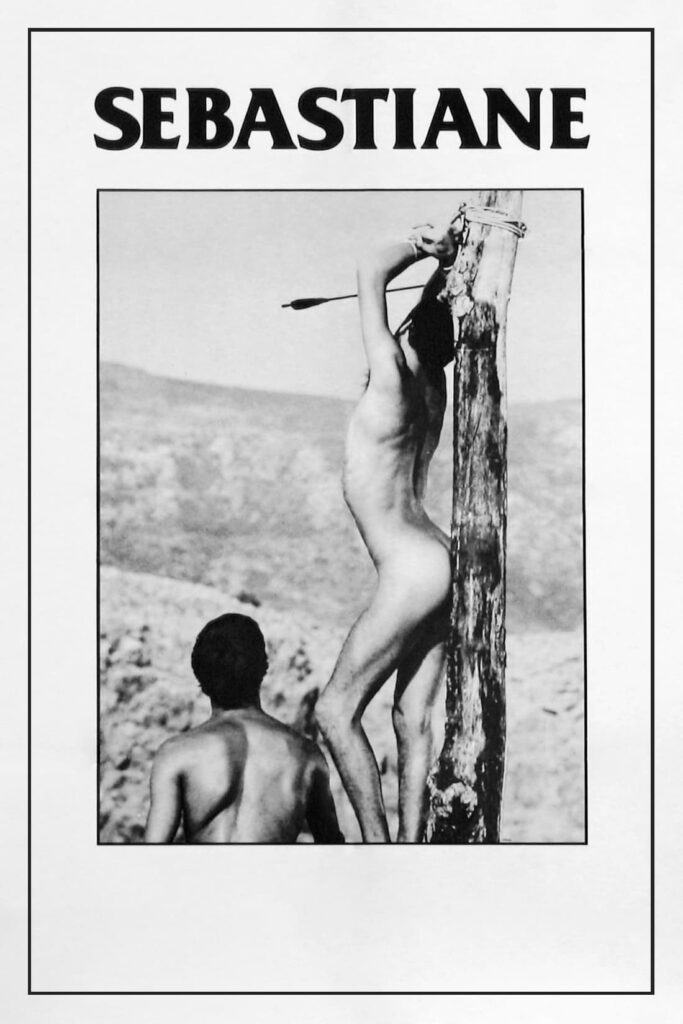
2024 Entry #024 01-18-24 “Sebastiane” is a 1976 Latin-language British historical film by openly gay director Derek Jarman (“The Angelic Conversation”, “Caravaggio”, “The Garden”, “Edward II”). Many members of the cast were gay and the film is famous (even notorious) for its controversially direct homoeroticism.
The film begins in Rome, AD 303, where Emperor Diocletian demotes Sebastian, his favorite captain of the palace guard to the rank of common soldier – Sebastian intervenes when the Emperor orders one of his male slaves to be strangled during a highly sexualized celebration of the sun. Sebastian is banished to a remote coastal outpost with his fellow soldiers. Sebastian is an early Christian who sublimates his desire for his male companions into worship of his deity and pacifism – which again, is also eroticized; Sebastian isn’t preaching the gospel so much as pining for his God; with his every breath he speaks of his God in sexy love poetry. Sebastian doesn’t go unnoticed though. Justin, one of his comrades in arms, is also in love with Sebastian, albeit necessarily unrequited, but he forms a friendship with the stubborn celibate pacifist. All of his comrades note his Christianity and castigate him for his faith. Indeed, his commanding officer, Severus, becomes increasingly obsessed with Sebastian, tries to assault him as he begs Sebastian to love him, and ultimately presides over his summary execution for refusing to take up arms in defense of the Roman Empire.
I had never seen this film before, though I’ve been aware of it for decades. I have seen two other Derek Jarman films, “Caravaggio” once, and “Edward II” many times over. If I have any excuse at all for skipping this film until now, it’s simply that there are now so many LGBTQ+ inclusive titles that I just haven’t had the time to get around to watching it – I mean, since 2020 and I actually devoted time to this subject matter, I’ve seen over 800 films, and I’m just now getting around to this one!
Having said that, I found this one quite entertaining – and quite daring, beyond what most creatives release today. The opening dancing ritual, which features men circled around a garishly painted man with his tongue constantly lashing, sees each of the circled men waving gigantic faux phalluses, who then pretend to penetrate the tongue lasher, and then finally splashing his face with what I assume is fake sperm. And by the time we get to the soldiers in the outpost male nudity is nearly constant. Among the men, Adrian and Anthony, two of Sebastian’s fellow soldiers, are gay and obviously in love with one another, which serves as somewhat of a balm after the orgiastic but ugly opening of the film and the equal hatred and lust thrust on the film’s hero.
Although it is far from an original thought, I was reminded that Christians were once the persecuted, but they are so often now the persecutors. Perhaps anyone in power is destined to persecute others? It’s really quite sad and upsetting. And I was also moved by homosexuality being portrayed so graphically in the 1970s, and that were it not for the AIDS crisis that followed, which, for example, ravaged several of the cast members and the film’s director, that this exploration might have continued and queer cinema might be something quite different today.