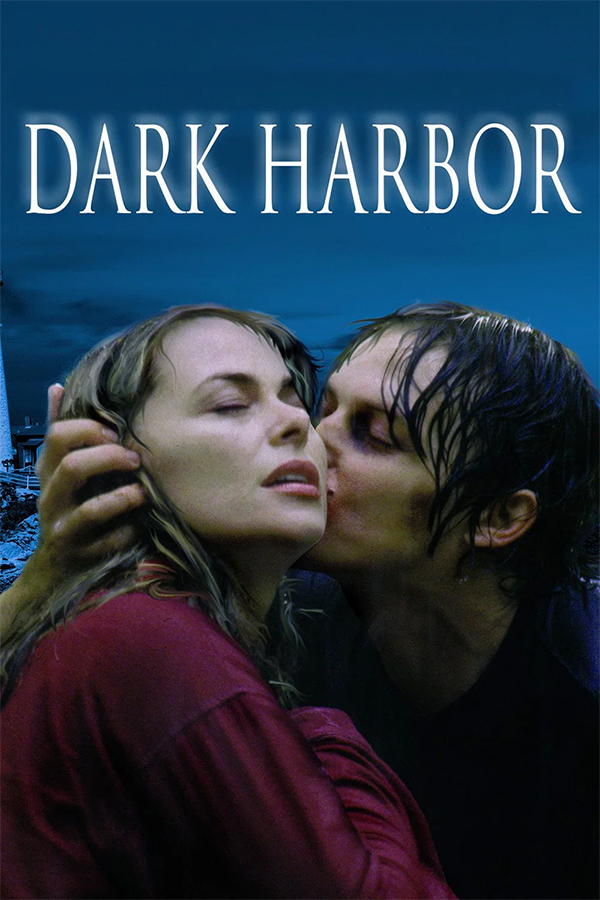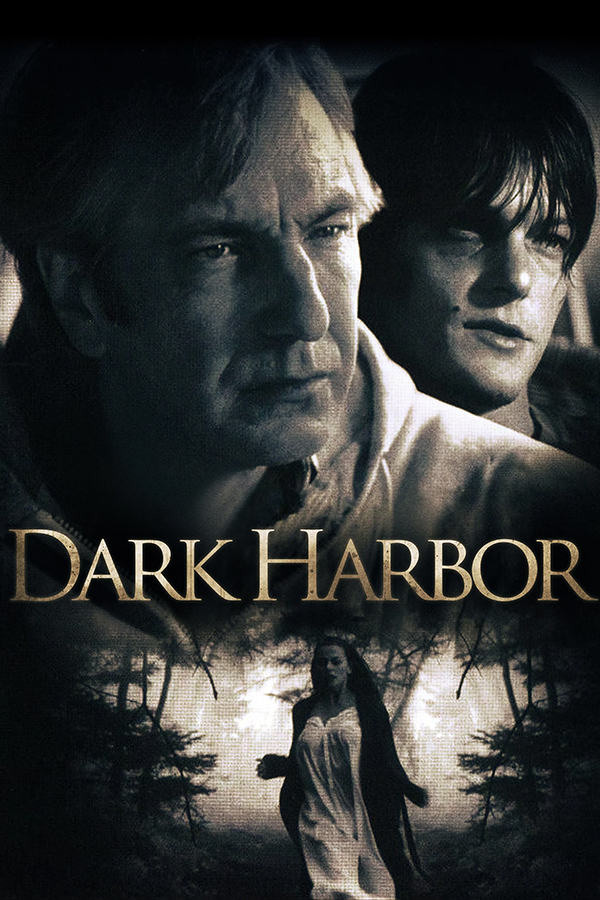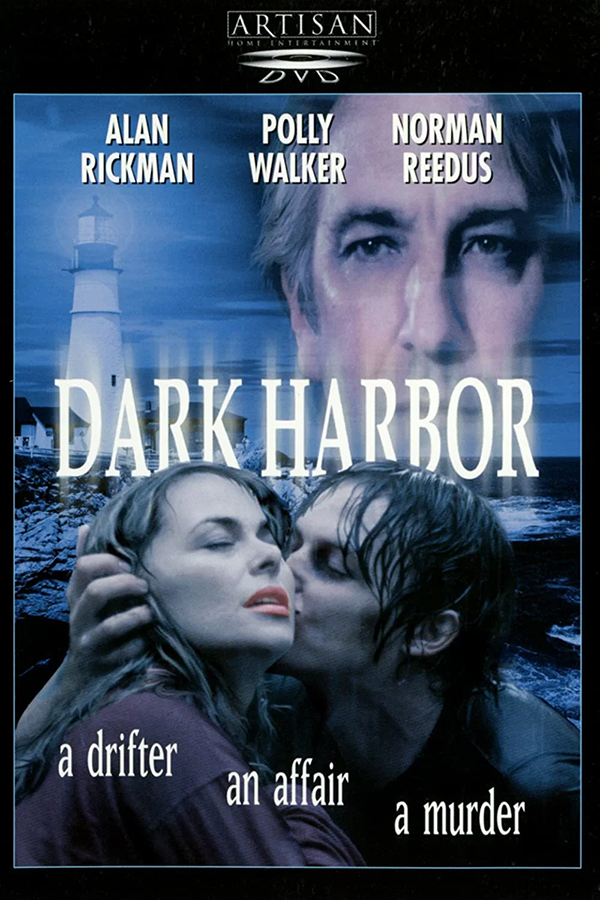
“Dark Harbor” (1998)

“Dark Harbor” is a 1998 thriller film written and directed by Adam Coleman Howard. It stars Alan Rickman (“An Awfully Big Adventure”, the Harry Potter films, “Perfume: The Story of a Murderer”), Norman Reedus (“Floating”, “The Boondock Saints”, “Beat”, “Luster”) and Polly Walker (“Scenes of a Sexual Nature”, “Caprica”). The aimless story follows David Weinberg (Alan Rickman), a lawyer in his 50s, and his much younger wife Alexis (Polly Walker) when they cross paths with an injured young man (Norman Reedus) at the side of the road, whom they reluctantly drive to the nearest town.

To discuss this film I’ll need to somewhat SPOIL the ending, so be warned.

I’d seen this film once before when I purchased it for my collection, having heard that there was a gay storyline. I remembered being relatively distracted by it, though when I tried to remember anything in detail I could clearly remember the final 5 minutes of the film and little else. Having revisited it, I can see why that is. For most of the film’s runtime, it plays like a timid, well meaning, but rather disjointed television film which leads to a twist ending involving a murder, followed by an unexpected nude scene from Rickman (which works well thematically but feels oddly risqué after the bulk of this prudish tedium), followed by a big gay reveal at the end, which ineffectually attempts to recontextualize much of what we’ve seen up to this point. But even knowing the twist and watching to see how the film played out given these previously hidden details, it still felt scattered and emotionally incoherent – leaving this so-called thriller bereft of any thrills beyond the twist itself, which is too bad. I enjoy all of these performers much more in other pieces and the movie isn’t exactly horrible so much as deeply flawed. But unless you’re a completist I’d suggest skipping this one.

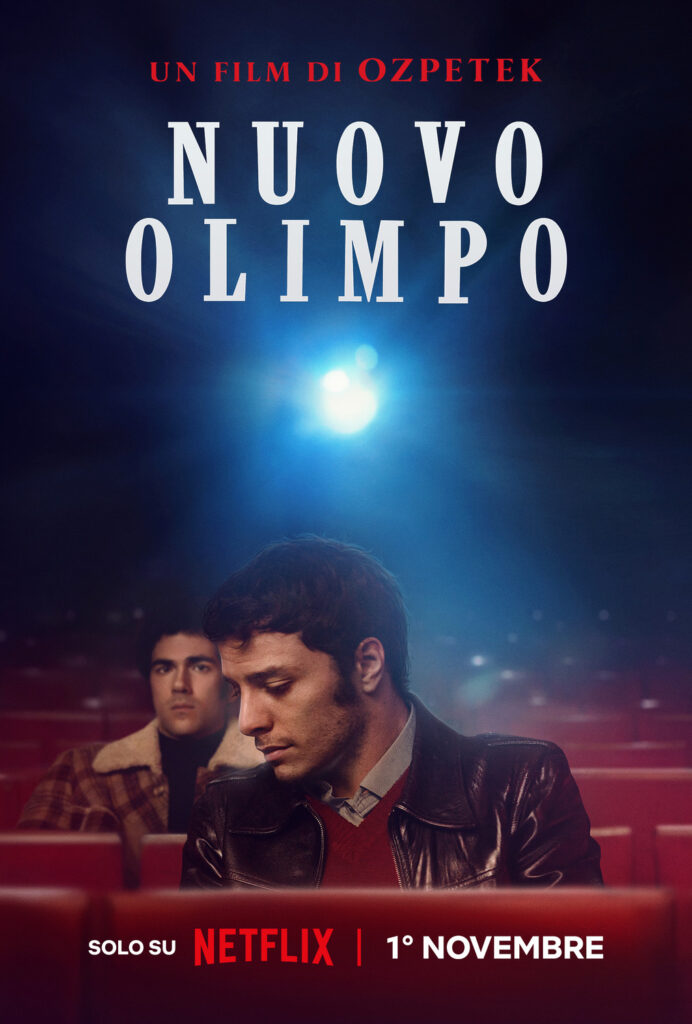
“Nuovo Olimpo” (2023)

“Nuovo Olimpo” is a 2023 semi-autobiographical Italian romantic drama film by openly gay director Ferzan Özpetek (“Hamam” / “Steam: The Turkish Bath”, “The Ignorant Fairies”, “Facing Windows”, “Saturn in Opposition”, “Loose Cannons”, “Magnificent Presence”, “Fasten Your Seatbelts”, “Red Istanbul”, “The Goddess of Fortune”) who co-wrote the film with Gianni Romoli. The story centers on Andrea Di Luigi as Pietro Gherardi & Damiano Gavino as Enea Monte, two men who meet and fall in love in late-1970s Rome, only to be separated unexpectedly. The film premiered at the Rome Film Festival on October 22, 2023 and was released on Netflix on November 1, 2023. Elements of the film’s story were taken from writer and director Ferzan Özpetek’s own life and career. He stated, “The starting point of the film is a true story that happened to me in the ’70s and that for a long time I wanted to use as an inspiration to make a film.” Nuovo Olimpo was shot entirely in Rome, specifically in Municipio III and Monte Sacro. Principal photography began in November 2022.

I’d previously seen and enjoyed both “Steam: The Turkish Bath” and “Facing Windows”, but until the release of this film in late 2023, I had no idea they shared the same creative team. But when I learned that Özpetek had directed both of those films and this one, I was immediately interested in seeing it.

I liked this though I’m not sure if I enjoyed it as much as his previous work. There are some wonderful sequences here and I adore the music he uses, and many elements of the story resonate for me in interesting ways. But I had a headache when I watched this which got progressively worse throughout, and this affected my experience and how I viewed it. I generally insist on subtitles vs. dubbing when I view foreign films because I love to hear the languages but because of the headache, after the film started and I found it was dubbed, I chose to keep watching because I wanted to see the movie so badly but I thought reading all the subtitles while I was impaired would be painful. I don’t think this choice ruined the movie, but I do feel like it added an extra level of camp, and if I ever view it again, I plan to view it with subtitles on.

The story features two bisexual men, Pietro & Enea, who fall in love with one another but are separated. Throughout their lives they consider one another and are haunted by their past relationship, despite moving on and finding happiness with other people. Their relationship pops up in all sorts of ways in the lives they choose to lead and eventually they are reunited, many years later, but to what end? This resonates with me. I’m demisexual; I form strong emotional bonds with nearly all the people I choose to have sex with, which is why I’m not good at one night stands and I’ve dated most of the people I’ve been with. These people, mostly men, who have been part of my life and drifted apart, I’ve often used their memory to create art (which is something the Enea does here) – and this has led to reunions, however brief, which feature old lovers speaking with some of the same results seen here. The film is a fiction based on real life, and that is exactly what it feels like. There are meta elements which are interesting and add something to the equation, pushing the life as fiction narrative…which border on gimmicky, but are really just another side of the truth. And the film features several supportive female roles that I found quite moving, if a bit underwritten; I liked all of these women but I’m not sure I truly knew them by the end of the film or that I fully understood them – and I wish we got more of that somehow. It’s not a perfect film but it’s a beautiful attempt.

“Nuovo Olimpo” is currently streaming on Netflix.

Cruising (1980)

“Cruising” is a 1980 American crime thriller film written and directed by William Friedkin and starring Al Pacino, Paul Sorvino, and Karen Allen. It is loosely based on the novel of the same name by New York Times reporter Gerald Walker about a serial killer targeting gay men, particularly those men associated with the leather scene in the late 1970s. The title is a play on words with a dual meaning because “cruising” can describe police officers on patrol and gay men who are cruising for sex.

Poorly received by critics upon release, “Cruising” performed moderately at the box office. The shooting and promotion were dogged by gay rights protesters, who believed that the film stigmatized them. The film is also notable for its open-ended finale, which was criticized by Robin Wood and Bill Krohn as further complicating what they felt were the director’s incoherent changes to the rough cut and synopsis, as well as other production issues.

I have friends that enjoy this film and others who despise it. Some of the friends that enjoy it claim that the film shares an honest look at the leather community and seeing police officers both abuse and fight to protect the gay community was ahead of its time. Some of the friends that despise it feel that the film suggests that both homosexuality and murder are a contagion; that being gay and being a killer are linked within the film and that such behaviors can be passed on to others. I fall somewhere in the middle. I think it has positive aspects and that some of the film is very forward thinking…but I think most of that is undone by bizarre story choices by director William Friedkin…which some fans of the film either don’t pick up on at all or if they do, view as a successful twist of some kind. I disagree with the latter and view these choices as a failing of the film, which in the end is just a muddled heap of red herrings which needlessly complicate the plot and undermine what the rest of the movie mostly succeeds at.

To describe the strange choices I’m speaking of, which IMO ruin the movie, I’ll need to get into SPOILERS so if you don’t want to know just skip this bit…

However, for those of you who are interested, let me see if I can unravel this mess…

Steve Inwood’s character, Martino, is murdered in a peepshow with a clue left behind which links the crime to Richard Cox’s character, Stuart Richards, the father-hating homophobe whom Al Pacino’s character nails for all of the murders near the end of the film. However, the killer in this scene is NOT played by Richard Cox, but by Arnaldo Santana.

Arnaldo Santana plays a character named Lukas who is murdered by the killer in the St. James Hotel at the beginning of the film, but in this scene the killer is played by Larry Atlas.

Larry Atlas plays Eric, who is murdered in Central Park and in this instance we never see the killer’s face but it’s been stated by various sources that this is actor Richard Cox, the supposed serial killer revealed near the end of the film.

Seriously. The film suggests that all of the victims could be killers. There’s also a scene with another man approaching a gay bar that seems to be suggesting that another killer is on the prowl. It’s been said that this is what Friedkin intended, as he believed that there was more than one killer.

Surely that’s the end of this, right? Nope.

With the post-climax, off-camera murder of Ted (Don Scardino), the gay next-door neighbor who befriends Steve (Al Pacino) when he goes undercover to catch a serial killer preying on New York’s gay community, it is at least suggested that Ted has become a victim of Steve’s, who has been repressing desires he has discovered in himself, and has taken the place of the murderer, who also killed gays because he couldn’t face the truth of his desires. If that seems like too much of a stretch, this is what actually, conclusively happens in Gerald Walker’s 1970 novel on which the film is based, and Friedkin leaves us wondering if it has happened in the film, although he gives us a possible alternative: Ted may have been killed by Gregory (James Remar), his jealous roommate / lover / boyfriend.

Oh. And I didn’t even mention the police interrogation scene in which a big man in a jock strap saunters in and slaps people around. I’m not making this up.

That was a lot to unpack. And I’m tired. But suffice it to say that without the wacky twists of stunt castings and suggested multiple murderers (and a big man in a jock)…the film could have been very good and it still has its moments, but they get lost in all the “art”.

Your mileage may vary. 🏳️‍🌈

Much of this film’s plot and imagery, along with it’s odd choices (like said jock strap wearing police station moment) are recreated in the 11th Season of Ryan Murphy’s “American Horror Story”, which is titled “NYC”. So if you like this, then I’d recommend checking that out. One of the more interesting interpretations of the film “Cruising” is that the killers are not men at all but the then unknown AIDS epidemic, which would have been really clever, but very unlikely given when the film was made and released, so while the interpretation solves a lot of the issues with the movie, it feels like like a rationalization to “save” the film, rather than anything that the film intended to achieve. Having said that, “American Horror Story: NYC” makes the link that the film could not, which is maybe why that season of television far more than the film / novel it was so clearly based on.

“Claire of the Moon” (1992)

Entry 17 on my LGBTQ pandemic marathon. Today I needed comfort food…and I also realized I’d not been watching any lesbian movies so I went for this borderline awful guilty pleasure which I love with almost every fiber of my being. ❤ 🏳️‍🌈 It’s one of those queer movies where it’s almost great, isn’t quite up to snuff but has it’s heart in the right place. I re-watched it last year or the year before for the first time in at least a decade so I hesitated to make it part of this new viewing party thing but I’ve decided I’m just starting from scratch and can watch anything I want. lol And I really needed this today.

For those wondering, the movie was released in 1992, when such films were far more rare and it was a passion project, which I can respect. The film score (which is available to stream on Amazon Music) is beautiful. And I have happy memories of seeing this with a dear friend on video in 1994. I’m glad it’s part of my collection.

Edit: I have a more indepth review of this from my 2026 re-watch.

Edge of Seventeen (1998)

I just finished rewatching one of my all-time-favorite LGBTQ films: 1998’s “Edge of Seventeen”, directed by David Moreton, written by Moreton and Todd Stephens, starring Chris Stafford, and co-starring Tina Holmes and Andersen Gabrych. I hesitated on watching this one as I felt I maybe knew this one too well and I’ve been mostly viewing movies in my inclusive collection which I’ve either never seen or I’ve only seen once or twice…but I’d actually forgotten a lot of it, which just means I’m getting old.

The movie is set in 1984 / 1985 and is partially set at Cedar Point in Sandusky, Ohio (though the name of the park is changed for legal reasons and long shots of the park are clearly from the 90’s as the Raptor can be seen). My family spent a lot of time at that park and the first time I went was 1984 / 1985. The soundtrack is a love letter to the 1980’s and the movie manages to capture that era in a way that many others fail to do.

For example, I watched another movie from the collection on Friday which I’d never seen before called “The Curiosity of Chance”, which came out in 2006, is set in the 1980’s in Europe and features some of the same songs…but it just feels unreal; and it’s not helped by some less successful acting choices and a muddled script. I didn’t hate watching it though I’d never put it on a top 10 list. “Edge of Seventeen” though is TOPS for sure. Take it from a bottom who knows! ❤ 🏳️‍🌈 🏳️‍⚧

“My Own Private Idaho” (1991)

The LGBTQ movie pandemic lock down marathon continues…with Gus Van Sant’s 1991 masterpiece, “My Own Private Idaho”, which I’d seen many times before, but again, not in several years. And just like today’s other entry (“Edge of Seventeen”), I was surprised how much I’d forgotten of this film and I feel I noticed things that I never had before…perhaps because I’m seeing it so far removed from previous viewings? It probably doesn’t hurt that I watched it on a huge TV.

“My Own Private Idaho” was the first gay themed movie that I actively sought out. It was the first movie that I rented once I had a drivers licence and could get an account at a video store (Blockbuster). At the time I was incensed that any movie with LGBTQ material was flagged by Blockbuster as something that could only be rented by people 17 and older regardless of content…and yet I was also grateful as it made such properties easier for me to find, and I rented many other such films which had a lasting impression, even if they didn’t join the collection I’m enjoying now. Years later, I was hired at Hollywood Video and during my interview I mentioned my disdain for Blockbuster for this very reason, which impressed my new manager (DJ).

As for the film itself it was (and remains) for me a haunting, eccentric collage of tones and quirks which exhilarated me as a film fan, even as it sometimes frustrated me as someone yearning to see representations of my own experiences; something that’s faded with time and more satisfying portrayals. Having said that, the campfire scene in which River Phoenix’s sympathetic, narcoleptic street hustler Mike Waters confesses that he loves Keanu Reeves’ gay for pay Scott Favor – and that he wants to kiss him, was a breakthrough moment for me as a gay film fan, and for the actors as well – it’s cited in nearly every review I’ve read of the film…and I watched that part repeatedly.

“The Curiosity of Chance” (2006)

I hadn’t seen this one before, and sadly I was bit disappointed. I’ll talk about this a little more after I watch the next movie, which it reminded me of, but if I remember correctly, I liked the other film, “Edge of Seventeen” far more.

I should write a real review of this. Maybe I’ll revisit it someday and do that. But see the next entry and I’ll talk about it more.

“Bear Cub” / “Cachorro” (2004)


On April 14, 2020 I wrote:

“I watched this movie yesterday, which I’d owned for about 16 years and had never seen. It was great! I loved it. My only minor quibble with it was that they sometimes spoke very quickly so the subtitles were flashing so quickly across the screen that I could barely look at what was happening…but I suppose that’s my own fault for not knowing Spanish! I’m happy that I’m finally seeing these movies from my collection as I revisit others I’ve mostly not seen in years. ❤ 🏳️‍🌈 🏳️‍⚧”

Lookin gback now, in April of 2026, I remember loving this movie but at the time I wasn’t writing in depth reviews. This is one that plan to revisit at some point and give it a proper review.

error: Content is protected !!