
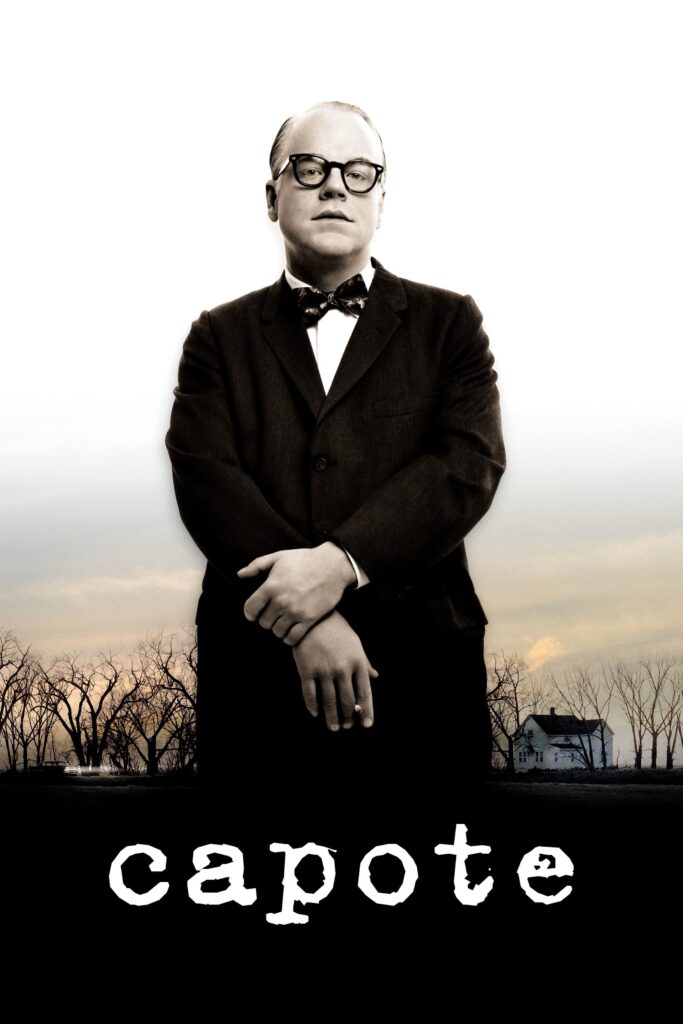
2024 Entry #009 01-04-24 “Capote” is a 2005 biographical drama film about gay American novelist Truman Capote directed by Bennett Miller, from a screenplay by Dan Futterman (“The Birdcage”, “Sex and the City”, “Urbania”, “Will & Grace”, “Political Animals”). The film stars Philip Seymour Hoffman (“Boogie Nights”, “Flawless”, “The Talented Mr. Ripley”), Catherine Keener (“Thelma & Louise”, “Being John Malkovich”, “Adaptation”, “Modern Love”), Clifton Collins Jr. (“Light It Up”, “The Rules of Attraction”, “American Girl”, “Scott Pilgrim vs. The World”, “Red, White & Royal Blue”), Chris Cooper (“This Boy’s Life”, “American Beauty”, “Adaptation”) & Bob Balaban (“Midnight Cowboy”, “Three to Tango”, “Howl”).
The film primarily follows the events during the writing of Capote’s 1965 nonfiction book In Cold Blood. The film was based on Gerald Clarke’s 1988 biography Capote. It was released on September 30, 2005, coinciding with what would’ve been Capote’s 81st birthday.
The film was successful at the box office, was well reviewed and the film was nominated for 5 Academy Awards including Best Picture, Best Director for Miller, Best Supporting Actress for Catherine Keener, and Best Adapted Screenplay, with Hoffman winning the Academy Award for Best Actor.
In truth, I’ve avoided this film for nearly 20 years. I was aware that the central character was famously gay, and that at least one other gay man was portrayed (Truman Capote’s partner, Jack Dunphy) and I now know that there are others mentioned (including James Baldwin), but I also knew that while the film centered on a homosexual character, that it was essentially sexless and I found this problematic. While films featuring queer sexuality were being celebrated, it seemed that only the most non-threatening portrayals were award worthy at that particular time – and this film’s Oscar win in the same year in which “Brokeback Mountain” was denied (while meeting every standard which historically had led to a Best Picture win) hurt me. Indeed, I’ve never watched the Oscars ever again, despite loving them up to that point. It still angers me. But here we are.
Although I’d never seen this before, I was familiar with a great deal of the subject matter, having seen the 2006 film about the same topic (“Infamous”) also having read a novel by Kim Powers called “Capote in Kansas: A Ghost Story”. It was fascinating seeing how “Infamous” and “Capote” chose to tackle the same events with very different results. Of the two films I’d say that “Capote” hit me harder, and the final act of the film was tortuous (in a complimentary way), but that I was more entertained by “Infamous”, it was more fun.