
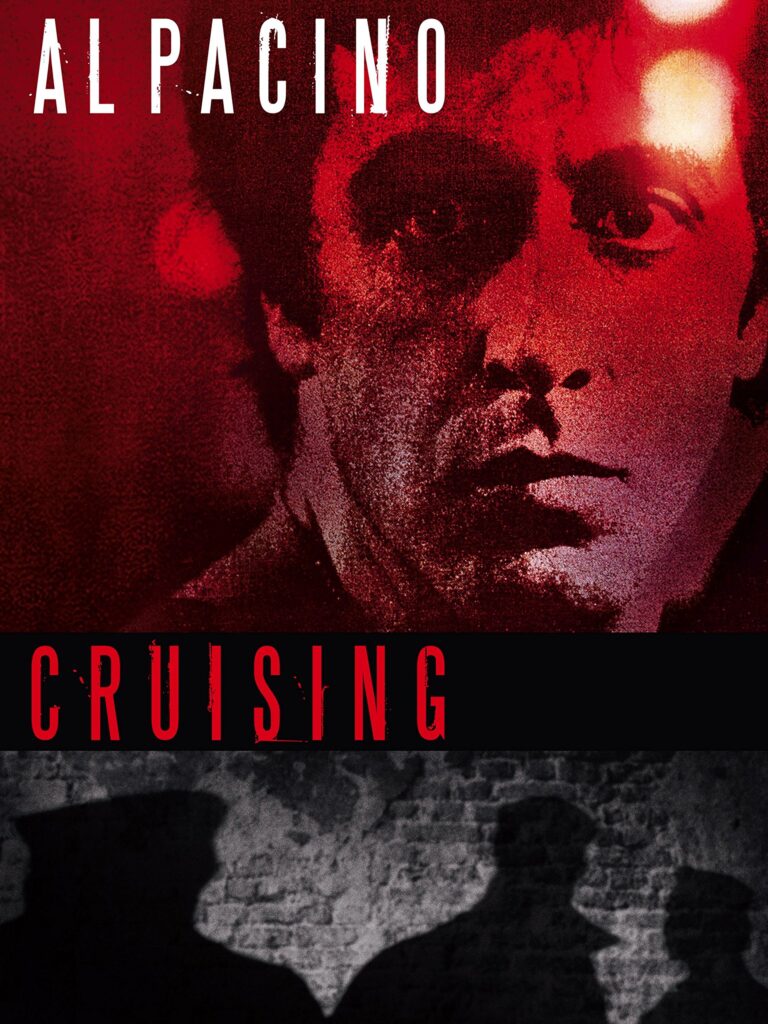
“Cruising” is a 1980 American crime thriller film written and directed by William Friedkin and starring Al Pacino, Paul Sorvino, and Karen Allen. It is loosely based on the novel of the same name by New York Times reporter Gerald Walker about a serial killer targeting gay men, particularly those men associated with the leather scene in the late 1970s. The title is a play on words with a dual meaning because “cruising” can describe police officers on patrol and gay men who are cruising for sex.
Poorly received by critics upon release, “Cruising” performed moderately at the box office. The shooting and promotion were dogged by gay rights protesters, who believed that the film stigmatized them. The film is also notable for its open-ended finale, which was criticized by Robin Wood and Bill Krohn as further complicating what they felt were the director’s incoherent changes to the rough cut and synopsis, as well as other production issues.
I have friends that enjoy this film and others who despise it. Some of the friends that enjoy it claim that the film shares an honest look at the leather community and seeing police officers both abuse and fight to protect the gay community was ahead of its time. Some of the friends that despise it feel that the film suggests that both homosexuality and murder are a contagion; that being gay and being a killer are linked within the film and that such behaviors can be passed on to others. I fall somewhere in the middle. I think it has positive aspects and that some of the film is very forward thinking…but I think most of that is undone by bizarre story choices by director William Friedkin…which some fans of the film either don’t pick up on at all or if they do, view as a successful twist of some kind. I disagree with the latter and view these choices as a failing of the film, which in the end is just a muddled heap of red herrings which needlessly complicate the plot and undermine what the rest of the movie mostly succeeds at.
To describe the strange choices I’m speaking of, which IMO ruin the movie, I’ll need to get into SPOILERS so if you don’t want to know just skip this bit…
However, for those of you who are interested, let me see if I can unravel this mess…
Steve Inwood’s character, Martino, is murdered in a peepshow with a clue left behind which links the crime to Richard Cox’s character, Stuart Richards, the father-hating homophobe whom Al Pacino’s character nails for all of the murders near the end of the film. However, the killer in this scene is NOT played by Richard Cox, but by Arnaldo Santana.
Arnaldo Santana plays a character named Lukas who is murdered by the killer in the St. James Hotel at the beginning of the film, but in this scene the killer is played by Larry Atlas.
Larry Atlas plays Eric, who is murdered in Central Park and in this instance we never see the killer’s face but it’s been stated by various sources that this is actor Richard Cox, the supposed serial killer revealed near the end of the film.
Seriously. The film suggests that all of the victims could be killers. There’s also a scene with another man approaching a gay bar that seems to be suggesting that another killer is on the prowl. It’s been said that this is what Friedkin intended, as he believed that there was more than one killer.
Surely that’s the end of this, right? Nope.
With the post-climax, off-camera murder of Ted (Don Scardino), the gay next-door neighbor who befriends Steve (Al Pacino) when he goes undercover to catch a serial killer preying on New York’s gay community, it is at least suggested that Ted has become a victim of Steve’s, who has been repressing desires he has discovered in himself, and has taken the place of the murderer, who also killed gays because he couldn’t face the truth of his desires. If that seems like too much of a stretch, this is what actually, conclusively happens in Gerald Walker’s 1970 novel on which the film is based, and Friedkin leaves us wondering if it has happened in the film, although he gives us a possible alternative: Ted may have been killed by Gregory (James Remar), his jealous roommate / lover / boyfriend.
Oh. And I didn’t even mention the police interrogation scene in which a big man in a jock strap saunters in and slaps people around. I’m not making this up.
That was a lot to unpack. And I’m tired. But suffice it to say that without the wacky twists of stunt castings and suggested multiple murderers (and a big man in a jock)…the film could have been very good and it still has its moments, but they get lost in all the “art”.
Your mileage may vary. 🏳️🌈
Much of this film’s plot and imagery, along with it’s odd choices (like said jock strap wearing police station moment) are recreated in the 11th Season of Ryan Murphy’s “American Horror Story”, which is titled “NYC”. So if you like this, then I’d recommend checking that out. One of the more interesting interpretations of the film “Cruising” is that the killers are not men at all but the then unknown AIDS epidemic, which would have been really clever, but very unlikely given when the film was made and released, so while the interpretation solves a lot of the issues with the movie, it feels like like a rationalization to “save” the film, rather than anything that the film intended to achieve. Having said that, “American Horror Story: NYC” makes the link that the film could not, which is maybe why that season of television far more than the film / novel it was so clearly based on.