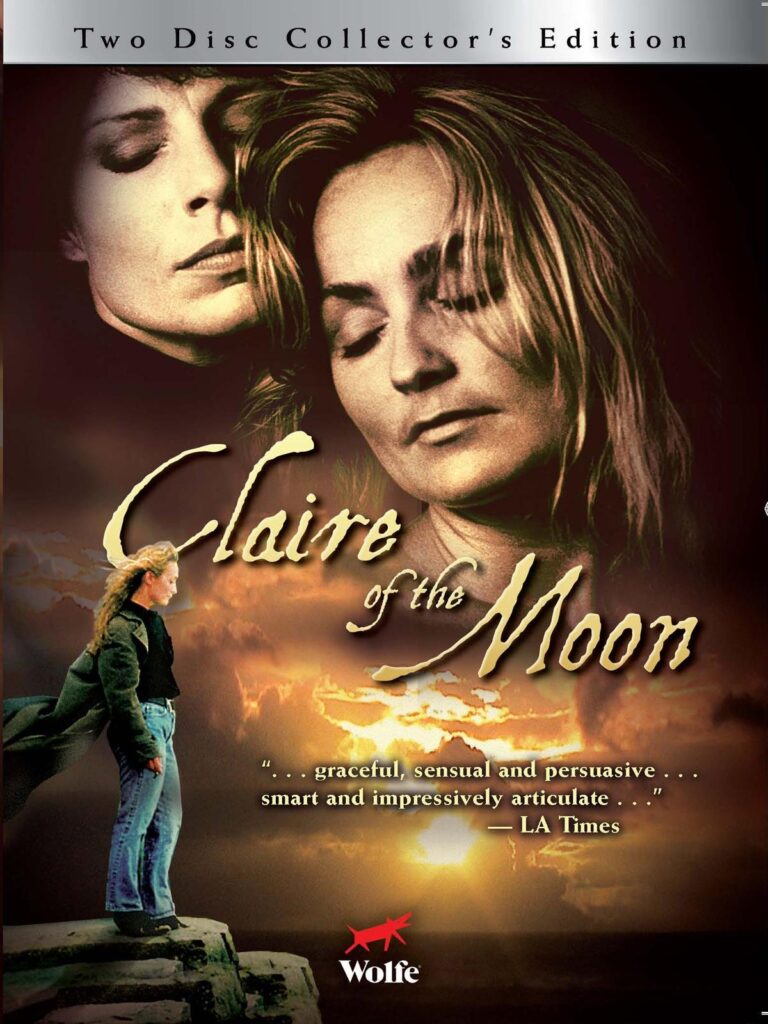
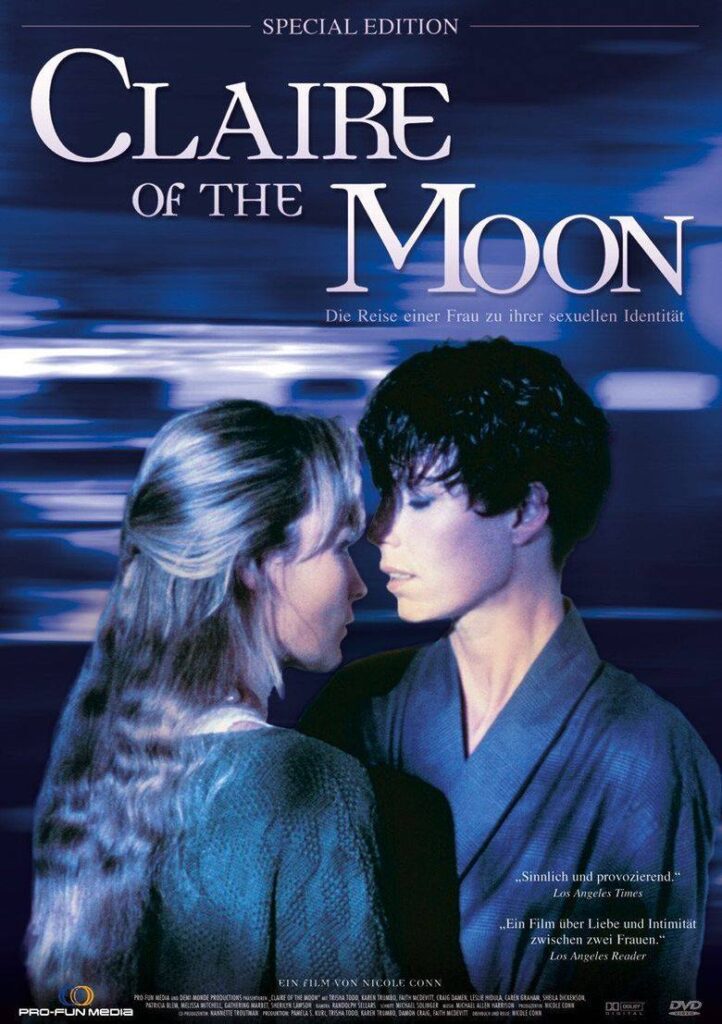
I first saw this movie on VHS in 1994 with my friend Jen Beam. She showed me 3 or 4 queer films that each left a lasting impression on me, and that may in part be why I love this movie as much as I do. It’s not great, and there are bits of it that are horrible, but it means well, and there are moments that really shine. The film score (by Michael Allen Harrison) is often stunning, just as much of the other music in the film is either bad or relatively forgettable. The performances are often more like caricatures, but for some reason I find this charming instead of annoying, and I’ve watched it 5 or 6 times, at least. I last watched this as part of my survival in NYC Covid-19 lockdown on April 21, 2020, but I barely wrote anything about it because it was one of the earlier entries before I knew that I was going to be watching and eventually reviewing over 800 LGBTQ+ inclusive movies from my collection. So, I’ll try to be better about that this time.
“Claire of the Moon” is a 1992 lesbian-themed erotic drama film directed by openly lesbian filmmaker Nicole Conn (“Elena Undone”, “A Perfect Ending”, “More Beautiful for Having Been Broken”) and starring Trisha Todd as Claire Jabrowski, a relatively famous published and seemingly heterosexual author, who decides to attend a retreat for all-female writers. While at the retreat she is forced to cohabitate with Dr. Noel Benedict (Karen Trumbo), an openly lesbian published author of a controversial book called The Naked Truth. The two live on opposite schedules but come to terms with a growing respect a rapport. The film centers on their budding relationship, but features the other women in supporting roles.
While the movie plays as a lesbian romance in an era that was nearly devoid of such films, the film also attempts to explore communication via Noel’s current work in exploring this topic through the subject of sex, theorizing that men and women speak wholly different languages, making it impossible for them to find true intimacy – while suggesting this is only possible via lesbian relationships. There are a lot of generalizations, but the film points that out as well, which makes the impassioned arguments a little hard to take seriously. But there are kernels of truth here and there which I wish had been expanded on more fully. At one point, while explaining her theory to her friends, she admits that sexual roles are complicated and possibly intrinsic, while she also struggles to define them and honestly explore them. She also discusses the vulnerability that partners must feel when exploring things that excite them as they risk rejection from those closest to them. There are no answers here and the discussions are murky enough to hide whatever the characters may actually be saying, but the discussion itself is an interesting topic that could have been explored in more depth. I also think it would have been fascinating for the other characters to have provided insight but they all seem willing to follow Noel on the matter – with the exception of Claire, but her objections seem to imply that she is wrong to disagree, which is fine, if a little simplistic. I should also say that I don’t mind everyone following Noel as I love the performance by Karen Trumbo, who sells the character’s obsession with tragic denial, even if I find the movie to be too in love with her backstory as a therapist in love with a client, which is a serious breach in ethics. But perhaps that was the point? I would have loved to have heard the filmmakers discuss this but I’m aware that I’m not the target audience and that I might take the film far more seriously than it needs to be. lol
I’ve always wanted to read the novel, but I’ve never owned a copy and it’s very difficult to find. I wonder if I might not get it through a library? Hmmm.