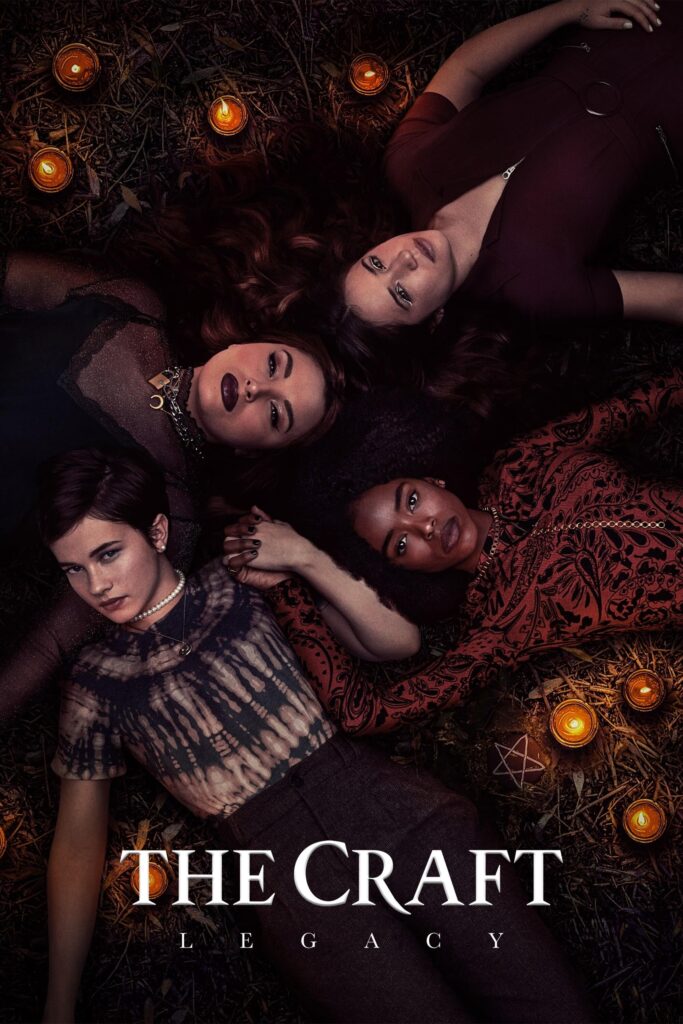
2024 Entry #55 07-21-24 “The Craft: Legacy” is a 2020 American supernatural horror film, written and directed by Zoe Lister-Jones, who is openly queer. A legacy sequel to 1996’s “The Craft”, the film stars Cailee Spaeny, Gideon Adlon (“When We Rise”), Lovie Simone (“Orange is the New Black”), and openly trans Zoey Luna as four teenage girls who practice witchcraft as a coven. Additional cast members include Nicholas Galitzine (“Handsome Devil”, “Bottoms”, “Red, White & Royal Blue”, “Mary & George”), Michelle Monaghan (“Kiss Kiss Bang Bang”), and David Duchovny (“Twin Peaks”, “Sex and the City”, “Queer Duck: The Movie”), with Fairuza Balk (from the original film) making a cameo appearance as her character, Nancy.
This was a disappointment. The first film is a guilty pleasure of mine; a cute teenybopper horror flick with enough style to get by and enough fun performances to remain entertaining long after the fact. But this sequel lacks most of what made the original worthwhile. The performances are all over the place and most of the characters are either annoying or extremely underdeveloped, often both. The movie gets points for featuring a transgender witch and a male bisexual character but the former is one of those underdeveloped characters and the latter is murdered, so was it really worth it in the end? Lead actor Cailee Spaeny comes off the best and Nicholas Galitzine is fun while he’s around, but nearly everyone else is either totally wasted or feel like they might be in an entirely different film. Fairuza Balk has more charisma in her single scene than many of the main characters.
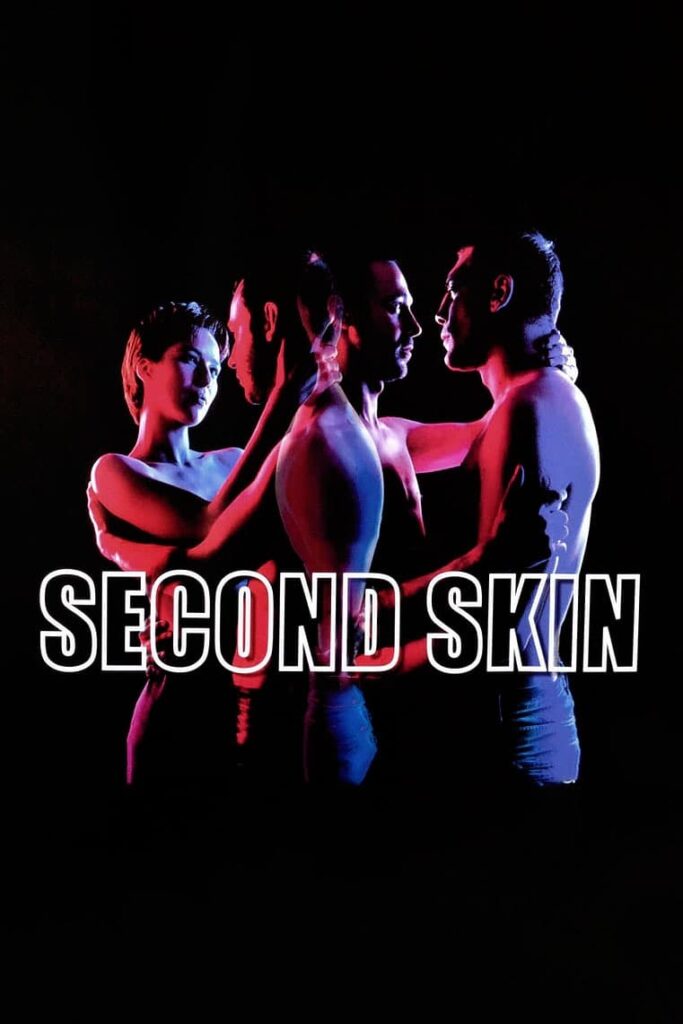
2024 Entry #44 04-15-24 “Second Skin” (aka “Segunda piel”) is a 1999 Spanish romantic drama film directed by Gerardo Vera, starring Jordi Mollà, Ariadna Gil, Cecilia Roth & Javier Bardem (“Not Love, Just Frenzy”, “Before Night Falls”, “Vicky Cristina Barcelona”, “Skyfall”). The story mainly follows the married relationship between Alberto (Jordi Mollà) & Eva (Cecilia Roth), along with their young son. What isn’t apparent at first is that Alberto is having an affair with a doctor named Diego (played by Javier Bardem), who is also unaware that Alberto is married.
I’ve owned this movie for 22 years but this was the first time I’d seen it. It plays like an old soap opera, a little too dramatic but still good. All the leads are great, especially Gil, and while Mollà’s Alberto at first just seems like a jerk, there’s something profound bubbling beneath the surface, which boils over into tragedy, yet I it was telegraphed so long in advance that I barely took note of the actual event. Still, I enjoyed this. And it was nice to see Bardem play a bottom with relish.
2024 Entry #026 “Vicky Cristina Barcelona” is a 2008 romantic comedy-drama film written and directed by Woody Allen. The film stars Javier Bardem (“Not Love, Just Frenzy”, “Second Skin”, “Before Night Falls”, “Skyfall”), Penélope Cruz (“Not Love, Just Frenzy”, “Head in the Clouds”, “Sex and the City 2”), Rebecca Hall (“Dorian Gray”) and Scarlett Johansson (“The Black Dahlia”, “Avengers: Endgame”) in lead roles. The plot centers on two American women, Vicky (Hall) and Cristina (Johansson), who spend a summer in Barcelona, where they meet an artist, Juan Antonio (Bardem), who is attracted to both of them, while still enamored of his mentally and emotionally unstable ex-wife María Elena (Cruz). The film was shot in Spain in Barcelona, Avilés, and Oviedo, and was Allen’s fourth consecutive film shot outside the United States.
I don’t generally enjoy Woody Allen movies. There are actually quite a few celebrated directors that I don’t enjoy. Examples: I mostly dislike the works of Brian De Palma (as I mentioned a few weeks ago) & Stanley Kubrick, and I think that most of Steven Spielberg’s films feel too “plastic” to be truly effective, though there are a few exceptions. Woody Allen is the same for me. I’ve not seen a lot of his work, but what I have seen, I haven’t loved or cared to revisit. It doesn’t help that he married his partner’s adopted daughter (which I have always found creepy) or that later evidence convinced me that he’s a pedophile – and I highly recommend watching Kirby Dick’s and Amy Ziering’s four-part documentary “Allen v. Farrow”. So why would I want to watch his work? That’s a fair question, and all I can say is that I’ve heard about this movie for years and I wanted to see it. I heard that it was inclusive. I love the cast. And a couple of years ago, I spent a few days in Barcelona, where the film is set. I have also previously reviewed films from convicted criminals and others whose views are directly opposed to mine. Sometimes I can pay more attention to the art than the artist, and other times I can’t. And I can’t explain why that is because I honestly don’t know. For instance, I have no problem re-watching the Wizarding World movies despite J.K. Rowling being a transphobe, yet I find the idea of re-reading her books (even though I already own them) difficult – and maybe that will change, or maybe it won’t. I just go with what my conscience will allow.
But what did I think of the movie? I liked it. I actually really liked it. I thought Scarlett Johansson’s performance was a little weak, but not horrible. I thought everyone else was fantastic. There were many times that I recognized different locations that I’d been to on my Barcelona trip, which was fun for me. And I honestly felt that while some of the situations seemed a little over the top, that the basic messages of the film were worth exploring and were honest in a way that over the top stories often aren’t. The inclusiveness involves Cristina forming a 3 way relationship with both Juan Antonio and María Elena, with the former spouses both finding value in featuring a third partner – both believing that Cristina is the ingredient that they lacked when they used to be a couple. I’ve known people who have experienced this. I’ve been involved with people experiencing this. And this is something that I’ve seldom if ever seen explored on screen. So that was one aspect I really enjoyed. But overall, while there was drama, I just liked that the movie was fun. The movie is light, while also exploring other facets of relationships that many will likely relate to. I wouldn’t call it a masterpiece or anything, but it was a good time. And that’s far more than what I was expecting.
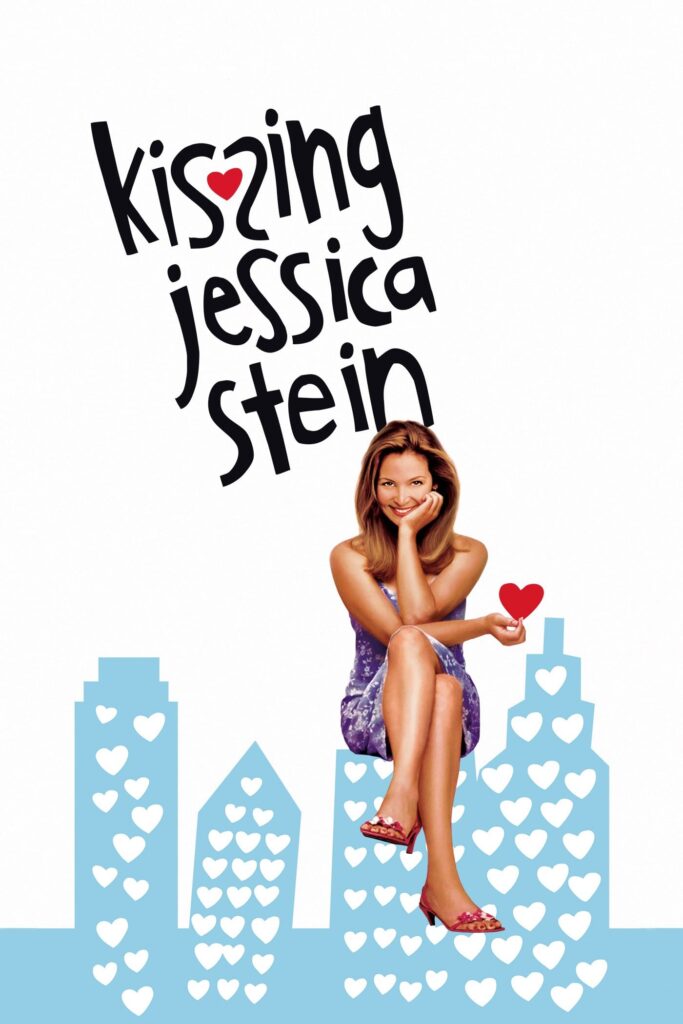
2024 Entry #011 01-07-24 “Kissing Jessica Stein” is a 2001 American independent romantic comedy film, written and co-produced by the film’s stars, Jennifer Westfeldt and Heather Juergensen; directed by Charles Herman-Wurmfeld (“Fanci’s Persuasion”, “Legally Blonde 2: Red, White & Blonde”, . The film also features openly gay John Edward Cariani (“The Good Wife”), Ben Weber (“Sex and the City”, “The Broken Hearts Club: A Romantic Comedy”) Tovah Feldshuh (“Friends & Family”, “Ugly Betty”, “The Good Wife”), Scott Cohen (“Oz”, “Gia”), Jackie Hoffman (“Queer Duck: The Movie”, “The New Normal”, “The Good Wife”, “Glass Onion: A Knives Out Mystery”), Brian Stepanek (“Six Feet Under”, “Green Book”), Jon Hamm (“Ally McBeal”, “Mad Men”, “A Single Man”, “Howl”, “Absolutely Fabulous: The Movie”, “Mean Girls”) & Michael Showalter (“Wet Hot American Summer”). The film is based on a scene from the 1997 off-Broadway play by Westfeldt and Juergensen called “Lipschtick”.
The story follows the title character, a Jewish copy editor living and working in New York City, who is plagued by failed blind dates with men, and decides to answer a newspaper’s personal advertisement, placed by a thirtysomething art gallerist, a ‘lesbian-curious’ woman. I had seen this movie once before, when I purchased it for my collection, when it was relatively new – so close to 22 years ago. Of that viewing, I remembered a powerful scene between Jessica (Jennifer Westfeldt) and her mother Judy (Tovah Feldshuh) on a swing, in which Judy reveals that she is supportive of Jessica’s relationship with Helen (Heather Juergensen), the gallerist; I cried both times that I saw it. The other scene I remembered was the breakup between the two women and the reasons for it. Otherwise, I remembered nothing; not even that it was set in NYC.
This movie is a bit of a mixed bag for me. I enjoy it, but I could have loved it and I didn’t. I think there are a few really successful ideas here about relationships and what constitutes a healthy one; how people can inspire us to be better than we were before – and can simply inspire us to do our best, our most creative work, which isn’t the same thing. But I think the tone of this piece is a little too “safe” and is so hellbent on being fluffy and fun that it often does a disservice to the strength of these messages. And I think that this silly romantic comedy occasionally gets out of its own way and allows for depth and honesty.
And then there’s the other problem, which may be more problematic for some than others: I’m not certain there are any lesbian characters in this supposedly lesbian themed film. I think if the film stood its ground more often and didn’t pull its punches this would be less annoying, because there is something to be said for the experiences of women who have relationships with women beyond lesbianism, but because it plays everything as frothy and weightless, that subject matter is presented as nearly devoid of anything of worth, and it didn’t have to be that way. But because of that, I wish the film had just allowed these characters to be lesbians. A fun lesbian comedy would be both easier to convey and a more welcome story to discover, as finding lesbian films which actually feature lesbian characters, who aren’t there only for decoration or flavor seems to be shockingly rare. Though I do give the movie some props for one of the bisexual women ending up with a woman, as her ending up with a man would have been so obnoxious as to spoil the film altogether.
Overall, this IS a silly romantic comedy, but every now and again there is something of greater value to be found here, which suggests this story could have been something much better.
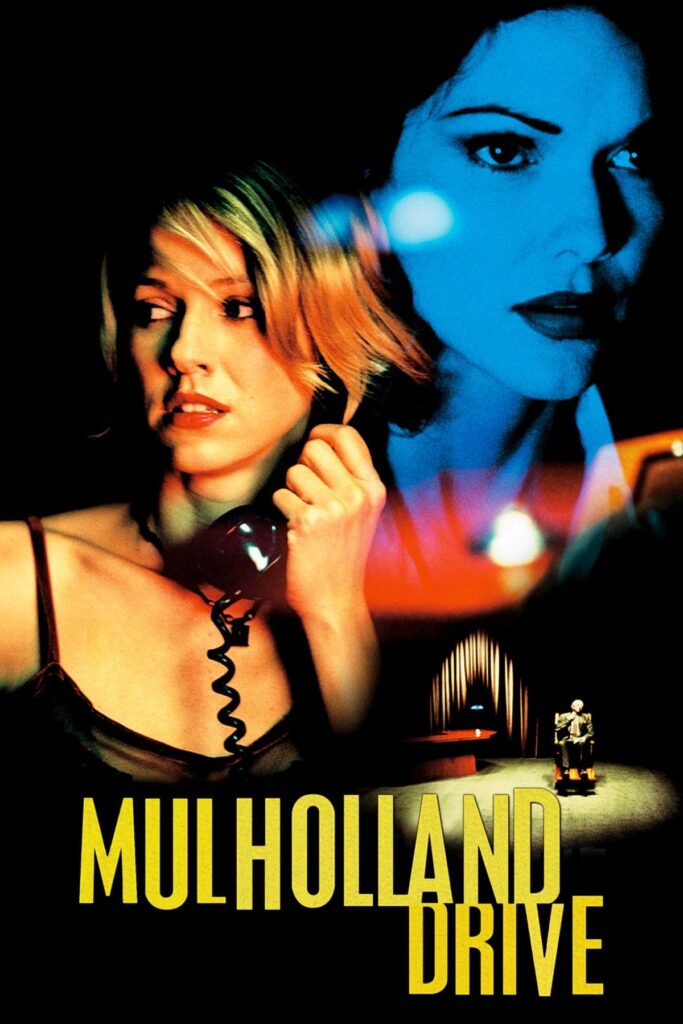
2024 Entry #010 01-06-24 “Mulholland Drive” (often stylized as “Mulholland Dr.”) is a 2001 surrealist mystery film written and directed by David Lynch (“Dune”, “Wild at Heart”, “Twin Peaks”, “Twin Peaks: Fire Walk With Me”). The film stars Naomi Watts (“J. Edgar”, “Feud: Capote vs. The Swans”), Laura Harring (“Gossip Girl”, “Law and Order: Special Victims Unit”), Justin Theroux (“I Shot Andy Warhol”, “Ally McBeal”, “Sex and the City”, “American Psycho”, “The Broken Hearts Club: A Romantic Comedy”, “Six Feet Under”, “The Sleepy Time Gal”, Mark Pellegrino (“Capote”) and Robert Forster (“Desperate Housewives”) and was the last feature film to star veteran Hollywood actress Ann Miller.
The film seemingly tells the story of an aspiring actress named Betty Elms (Watts), newly arrived in Los Angeles, who meets and befriends an amnesiac woman (Harring) recovering from a car accident and the two become lovers. The story follows several other vignettes and characters, including a Hollywood film director (Theroux). In the final act there is a jarring change of perspectives in which many of the roles we’ve been following are altered, and the audience is left to decide for themselves what actually happened. Despite this unconventional twist, “Mulholland Drive” is often regarded as one of Lynch’s finest works and as one of the greatest films of all time. It was ranked 8th in the 2022 Sight & Sound critics’ poll of the best films ever made and topped a 2016 BBC poll of the best films since 2000.
It might surprise some (and disappoint others) that I had never seen this film before watching it yesterday. Despite loving the original “Twin Peaks” series, the prequel film “Twin Peaks: Fire Walk With Me” and Lynch’s version of “Dune”, I generally don’t think of myself as a big David Lynch fan. I saw “Lost Highway” in theaters and fell asleep, but I hated what I did see and I’ve never been tempted to revisit it.
Having said that, I found this piece to be quite moving at times, disquieting at others. In the beginning, following the opening credits, I disliked the film’s tone, which was epitomized in Naomi Watts and her performance. However, the change in perspectives (among others things) changed my response as well. I didn’t write this review right away because I wanted to spend some time with my thoughts on the film, and I’m convinced (like many others) that the final section of the film is the true tale, while everything after the opening credits up to that point is a kind of fantasy or self deception, which circles back around at the end of the film. It’s complicated, clearly. I can see why so many people both love and hate it. I think I love it. I may need to watch it again at some point. In retrospect, this feels like a masterpiece, but while I was watching it, I didn’t feel that way at all – which itself is fascinating.
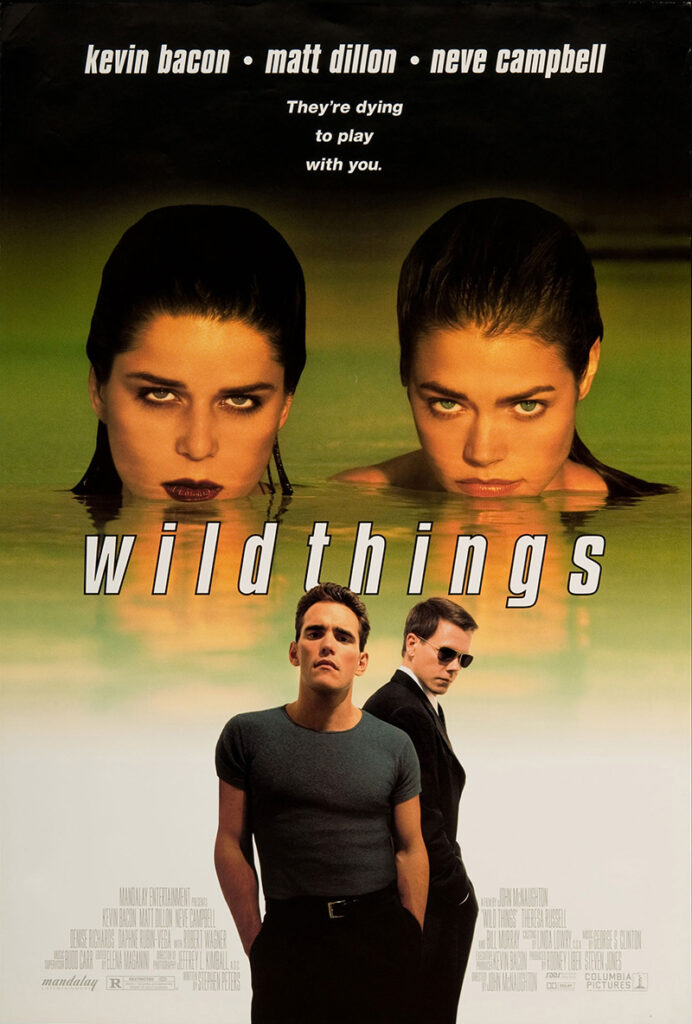
2022 Entry #013 01-30-22 “Wild Things” is a delightfully trashy 1998 American neo-noir erotic crime thriller film directed by John McNaughton and starring Matt Dillon (“In & Out”), Neve Campbell (“54”, “Three to Tango”, “Intimate Affairs”), Kevin Bacon (“Queens Logic”, “Beauty Shop”), Denise Richards (“Nowhere”), Bill Murray (“Tootsie”, “Groundhog Day”), Theresa Russell (“Black Widow”) & Daphne Rubin-Vega (“Flawless”, “Sex and the City”, “Smash”, “Rent: Live”, “Tales of the City” “tick, tick…BOOM!”). The story is set in south Florida, where a high school counselor (Dillion) is accused of rape by two female students (Campbell & Richards), but the police officers investigating (Bacon & Rubin-Vega) suspect something more is going on.
I’m sure this movie makes a lot of people’s guilty pleasure lists. Most of the characters (like “Basic Instinct”) are horrible people, but they’re so much fun! But why is the movie on this list? Spoilers follow, which frankly, are more fun to discover on your own if you’ve not seen it. But if you don’t care, then feel free to continue.
The film reveals (or at least implies) that Neve Campbell’s character, Suzie Toller, was lovers with Denice Richards’s character, Kelly Van Ryan, before the start of the film…and that she is also (secretly) Kelly’s aunt. The question of if that backstory is true or not is because this a twisty puzzle of a movie and it’s possible that some of that backstory is forged…and yet even if it’s all a lie…there’s more. During the film, Suzie and Kelly have sex, both with Dillon’s Sam Lombardo along as an instigator, and on their own. In addition to that, there’s a subtle homoeroticism between Lombardo and Kevin Bacon’s Sergeant Ray Duquette. In the film, Lombardo calls Duquette a cocksucker and the reaction from the Sergeant is priceless; and maybe it’s just me, but it left me feeling like Duquette has sucked off Lombardo at some point. If that seems too tenuous, there’s a famous scene later in the film where Lombardo returns to his cabin to find Duquette in his shower, with Kevin Bacon going fully frontal, and the two seem totally comfortable with this scenario. Mix this with Bill Murray’s sleazy lawyer character questioning if the student accusing Lombardo is male or female, Lombardo’s deck hands and him later putting Duquette in that role and there’s a lot of suggestion going on.
I read somewhere years ago that the creative team had toyed with making the men lovers but that they felt like that might cross a line, and as much as I would have loved to see it, they were probably right. The LGBTQ audience had started boycotting films that portrayed all the queer characters in movies as murderous, duplicitous monsters…and they may well have skipped this movie if that were the case here. And straight male audiences, tend to not go for gay male movie storylines; the inclusion and upset over minor gay characters in recent animated and comic book based films is unfortunately testament to that. And of course straight men and women generally find bi or lesbian women either titillating or completely non-threatening. Still, this movie felt like something a bit more than the usual girl on girl tease.