BTAS = Batman: The Animated Series (85 Episodes)
BARA = Batman & Robin Adventures (28 issues)
TBA = The Batman Adventures (comics)
1991:
001 BTAS 32 S01E51 Robin’s Reckoning, Part I
002 BTAS 33 S01E53 Robin’s Reckoning, Part II
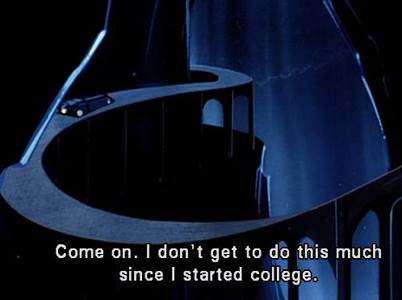
The reasons I have come to believe that “Robin’s Reckoning” is the proper beginning to the DC Animated Universe are as follows. For one thing, I think that the first episode in a chronology should serve as some kind of springboard for the rest of the series. In this case, I wanted an episode that explained some of the back story of who Batman is. My first impulse was to begin with “Batman: Mask of The Phantasm” as that film clearly explains how Batman came to be, but the film also features the Bat-Signal being used, and in dialogue reveals that it’s been in use for some time. The Bat-Signal is introduced in “The Cape & Cowl Conspiracy”, so the use of the Bat-Signal killed that idea; which bummed me out, as the film would have served as an epic beginning to what is to come. “Robin’s Reckoning” on the other hand insinuates Batman’s origins, while giving Robin a history, and letting the audience know that he’s attending college, so we understand why he isn’t in every episode.
On a side note, in the Justice League Unlimited episode “Epilogue”, which was produced with the belief that it would be the final DC Animated Universe installment, the ending of the episode mirrors the opening scene of the first DCAU episode produced, “On Leather Wings”, which gives the ending of that J.L.U. episode special meaning, so I briefly considered “On Leather Wings” for the opening episode here, but it doesn’t really make sense to me. Besides, knowing that “Epilogue” mirrors the first episode produced is enough, and seeing the episodes in a different order takes nothing away from that inside knowledge. When I had considered “Mask of the Phantasm” as the opening, that seemed perfect, because the Phantasm is also featured in “Epilogue” and therefore the intended final episode would mirror both the first produced, and first chronological episode, but it just wasn’t meant to be. Beyond that, “Epilogue” was not the last DCAU episode produced, and there are some (including myself) who don’t view it as the final chronological episode either.
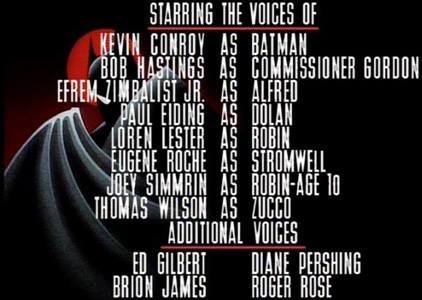
In the DCAU there is no mention of Dick “Robin” Grayson’s true age in the present timeline of the shows. During the flashbacks in “Robin’s Reckoning, Part I” Dick Grayson is listed as Age 10:
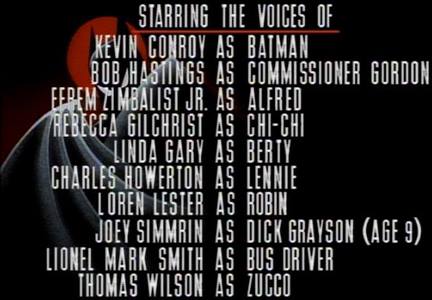
That’s pretty simple right? Only it’s NOT. Because in the flashbacks during Part II, which clearly take place after those in Part I, Dick Grayson is listed as being 9 years old:
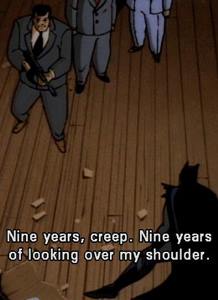
Given the nature of the flashbacks one of the ages given has to be wrong, but which one is it? Well, from dialogue in Part II we know that 9 years have passed since the flashbacks:
We also have this dialogue from Part I:
“You deceived me. You can’t take this one. Zucco’s mine!.” – Robin
“Sorry, Robin, but on this team, I call the shots.” – Batman
“But I’ve waited half my life!” – Robin
So 9 years has been half of Robin’s life, meaning he was 9 in the flashbacks and is 18 now. The line about being in college seems to make sense too as most people seem to enter college around that age; some of them sooner. So that’s how I figured that one out. I didn’t just pick one at random. In the flashbacks, Commissioner Gordon is a Lieutenant who refers to Batman as “this Batman” as if he doesn’t know him yet, which makes this a good intro to the character. The flashbacks also feature a rookie cop who looks like (and is likely intended to be) Harvey Bullock, and include the Batwing, but not the Batmobile, which means the flashbacks from “The Mechanic” may take place after the flashbacks here. The Batcave is also bereft of Two-Face’s coin, the Ventriloquist’s Dummy, the Freeze Gun – and no Bat-Signal is used in the episode – which permits the episode to be placed before those objects were introduced.
These episodes also feature flashbacks to 1982 (9 years before the episodes).
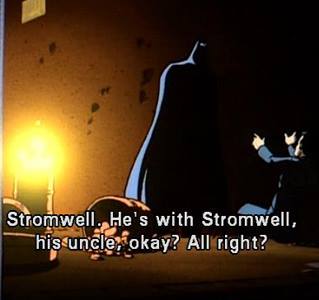
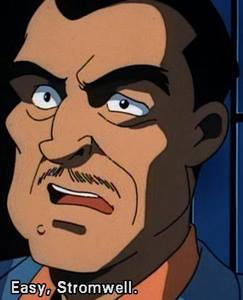
The introduction of Arnold Stromwell during the flashbacks in Part I helped set up the next episode.
003 BTAS 12 S01E06 It’s Never Too Late
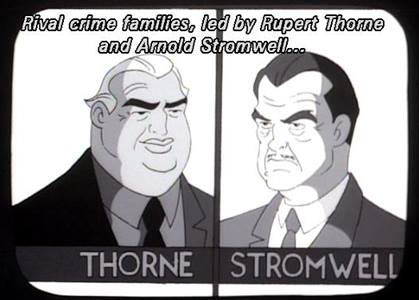
The character of Arnold Stromwell, seen in the flashbacks of “Robin’s Reckoning, Part I”, is featured and finds closure in “It’s Never Too Late” – there is no way to know which episode should be viewed first, but after I chose to begin with “Robin’s Reckoning”, the other appearance of the character seemed like a perfect coda to the 2-parter, and thusly “It’s Never Too Late” fell into place as episode 03 of B:TAS.
There are more flashbacks in this episode; this time it’s to Stromwell’s childhood so the date is unclear but the actual date isn’t particularly important. The use of flashbacks ties it to the previous story and to the next few episodes as well.
004 BTAS 03 S01E10 Nothing to Fear
Dr. Jonathan Crane / The Scarecrow is introduced here and is captured. The use of flashbacks continues with the backstory for Dr. Crane.
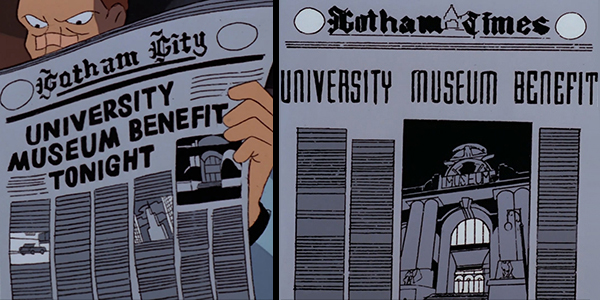
The image on the left is from “Nothing to Fear”. The image on the right is from “Heart of Ice”. In the latter episode, which is demonstrably set in 1992, Bruce looks through newspaper clippings set in 1991 and one strongly alludes to the events of “Nothing to Fear”, while another references the events of “Pretty Poison”, supporting the placement of the latter two stories in 1991 along with the past events of “Heart of Ice“.
First mention of S.T.A.R. Labs which will be featured in Superman: The Animated Series and Justice League Unlimited. Axis Chemicals is also referenced which is where Jack Napier became the Joker.
Bruce’s father Thomas Wayne is seen and heard in this episode via Fear Toxin – Thomas and Bruce’s history was implied in “Robin’s Reckoning”. At the end of this story, Bruce leaves flowers on the grave of his parents, something that will be revisited in “Mask of the Phantasm”.
005 BTAS 55 S01E48 The Mechanic
Batman villain the Penguin has no origin episode within the DC Animated Universe so it was difficult finding a first episode for the character. I ended up choosing this one because it’s the implied first appearance of one of Penguin’s henchmen (Falcone).
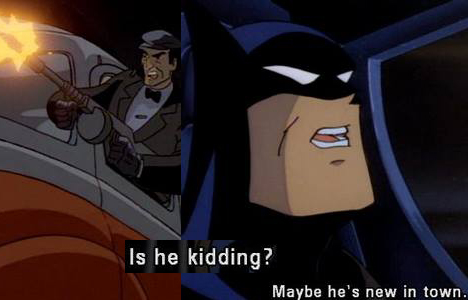
The introduction of Falcone is important because he returns later in the year (in “Blind as a Bat“), along with Penguin’s other cohorts seen here: Eagleton & Sheldrake. In still more flashbacks we see the previous Batmobile and that Bruce is already wearing his Batsuit.
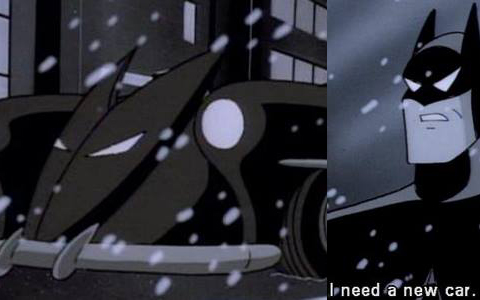
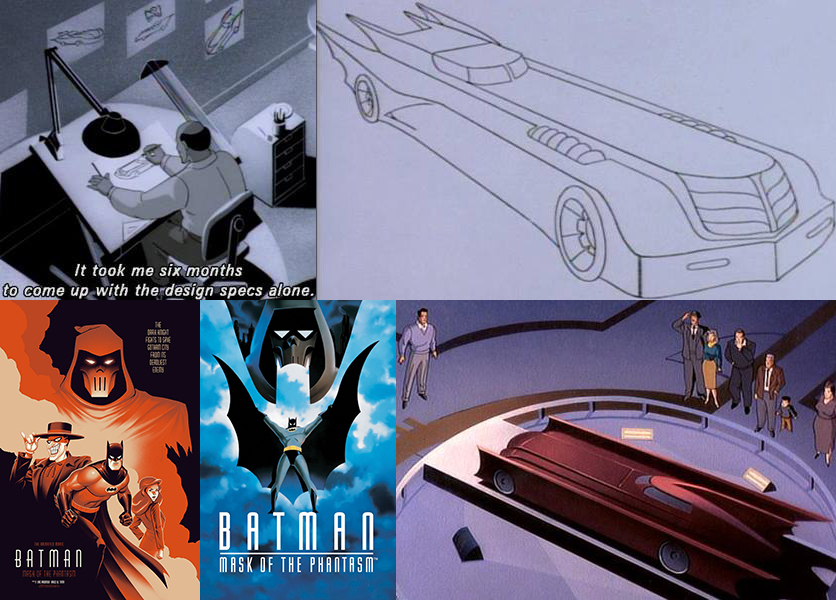
It’s also said that Batman’s mechanic designed the current Batmobile, though in “Mask of the Phantasm” Bruce spies a nearly identical design back in 1981, before these flashbacks take place (which we know because the Phantasm flashbacks are set before Bruce dressed as Batman). Perhaps Bruce told his mechanic what he wanted and he worked from that concept?
006 BTAS 09 S01E11 Be a Clown
I knew I wanted to place the episode “Zatanna” (which features flashbacks to 1979) early in the series as it, again, helps explain Batman’s origins but that episode features a scene that foretells the coming of the Joker, which is more powerful if one knows who the Joker is. It can probably be assumed that EVERYONE knows who the Joker is, but I wanted my episode order to be supportive of new viewers and new fans of the DC Universe in general so I thought it would be more dramatic to have a Joker appearance before “Zatanna“. But which one?
This episode met several criteria to be the first DC Animated appearance of the Joker. While Mr. J appears in more Batman episodes than any other villain, like Penguin, he has no true origin episode; there’s no installment that begins with him as Jack Napier and then ends with him as the Joker, though his origins are insinuated and / or mentioned in later installments. So, with an origin story out of the question, deciding what episode he should first appear in was difficult. With the sheer number of Joker episodes it made sense to spread them out throughout the series run. I found that even though his henchwoman Harley Quinn originated in the first year of the series run that her first appearance was best served IMO by an episode that had to take place in late 1993 at the earliest (“Joker’s Favor”), which was somewhat supported by the continuity point in The New Batman Adventures episode “Mad Love”, which clearly shows the origins of Harley Quinn, including scenes that predate her criminal activity in a setting featuring Poison Ivy at Arkham Asylum, meaning that Harley could only be introduced 3 months after Ivy was taken to Arkham at the earliest; something we don’t see until later in the series….so Harley Quinn was deemed forbidden until episodes set in late 1993. I started looking at episodes featuring just the Joker, and split them up into different categories:
Episodes where Joker is free and escapes at the end.
Episodes where Joker is free and captured at the end.
Episodes where Joker escapes from custody and remains free at the end.
Episodes where Joker escapes from custody and is captured again.
Episodes where Joker cameos.
After all that I decided to start with one where he’s free, and then escapes at episode’s end, so I could pair it with a 2nd appearance in which he’s captured, both to give Joker more exposure and also to quickly burn two Joker episodes. This also gives the Joker flashback revelation in “Zatanna” an extra bit of a punch. The episode also introduces important recurring character Gotham Mayor Hamilton Hill; not only does he appear in many key episodes but he remains important in tying together Batman: The Animated Series to Batman Beyond, in which the teenage characters attend Hamilton Hill High School.
007 BTAS 04 S01E15 The Last Laugh (April)
So deciding what episode Joker should first appear in was difficult. As I mentioned above, this episode was chosen because it features the Joker already free which ties into the ending of “Be a Clown“. Also, “Be a Clown” and several other episodes end with the apparent possible death of the Joker who almost always manages to survive to return another day and seeing these episodes together serves to initiate new viewers to this odd Joker element.
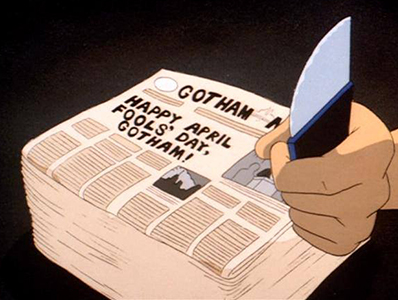
This is also the first episode with a clear date as a newspaper in the episode reveals that it’s April Fools’ Day, which is celebrated on April first. Knowing the date for this episode allowed me to set it before other episodes which take place in later months, and early enough in the year to accommodate the April setting.
008 BTAS 54 S01E50 Zatanna
This episode introduces an early love of Bruce’s named Zatanna, who will go on to become a much more powerful character in later appearances, and is yet another episode to feature flashbacks to give us still more history of these characters.
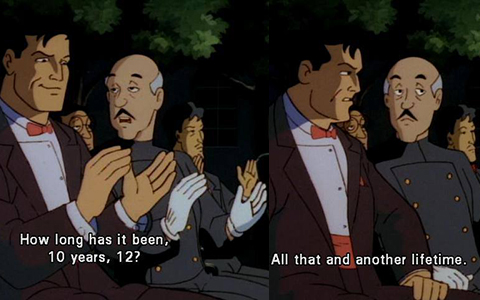
A conversation between Bruce & Alfred insinuates that the last time they saw Zatanna and her father Zatara was 12 years ago.
The episode is set in 1991, so 12 years before that brings us to 1979 as the date that Bruce ended his training with Zatara. I’ve always felt this episode should be viewed early in the series to allow for Zatanna’s growth from an illusionist to a full blown sorceress (as seen in Gotham Girls & Justice League Unlimited). Many fans have voiced the opinion that there is something of a continuity problem between her portrayal here and her other DC Animated Universe appearances, but I would point out that her true magical powers are insinuated in the flashback featuring a young Zatanna and Bruce:
Zatanna: “Here, pick a card. I’ll tell your future.”
(Bruce takes a card).
“I see emotion, intensity…two of hearts.”
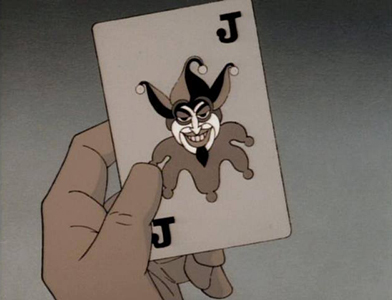
Zatanna foretold the coming of the Joker into Batman’s life a little over a decade before this episode. Given that example, it’s not much of a stretch to imagine her eventually growing beyond the slight of hand tricks she learned from her father, Zatara. I also thought placing this episode directly after two of the Joker’s appearances would help strengthen this insinuation – providing still more strands of connective continuity.
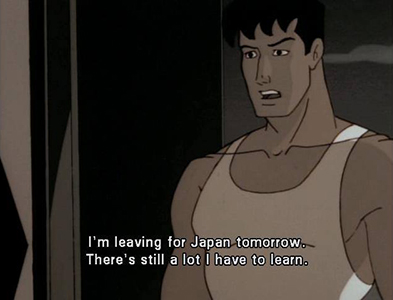
The flashbacks also flesh out Bruce’s training as an escape artist (which resonates with some of the imagery in “Be a Clown“), while simultaneously setting up another later episode (“Night of the Ninja“) with Bruce’s line about heading for Japan next. My first impulse was to place the latter episode as the next installment as a sort of direct sequel to this story but “Night of the Ninja” takes place in June so placing it so soon after “The Last Laugh” which was set on April first seemed like a mistake, so I instead found other installments which could effectively fill that gap.
009 BTAS 64 S01E59 Read My Lips
“Read My Lips” introduces Ventriloquist & Scarface, a new criminal mastermind operation with a bizarre secret. I placed this episode here because of its reference to the magician Zatara, Zatanna’s father, who trained Bruce Wayne in the art of escape, as seen in the flashback sequence in the previous episode, “Zatanna“. I liked the way that this reference tied these episodes together, giving more weight to that nod to continuity for anyone viewing the episodes in this order, and perhaps giving Bruce more cause to mention his teacher to Alfred here, as we know that Zatara and his daughter have both been on Bruce’s mind recently. And given that Alfred knew of their existence as well, it makes sense that Bruce would speak of them to him. The mention of Zatarra allows for an extension of story points introduced in “Zatanna” while allowing for more time to pass between “The Last Laugh” (April 1) and “Night of the Ninja” (June).
010 BTAS 14 S01E14 The Clock King (May)
The episode begins with a flashback to 7 years before the episode, on May 12 (per a computer screen), the day that Temple Fugate loses everything; in the flashback to 1984 we get to see Mayor Hamilton Hill shortly before he became mayor.
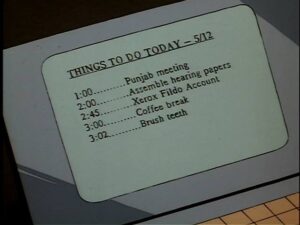
The episode then picks up 7 years later when Temple, now the Clock King, returns for revenge, which of course, is precisely timed.
The Clock King escapes at the end.
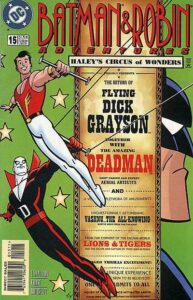
011 BARA Vol. 1 #15 Second Chances
Which brings us to our first Batman: The Animated series tie-in comic. A followup to “Robin’s Reckoning“, this story is placed between “Read My Lips” and “Night of the Ninja“, to extend the time between the setting of “The Clock King” (mid May) and “Night of the Ninja” (June), while not losing any of the momentum of these interconnected early adventures.
This story introduces us to Boston Brand / Deadman, who will recur in several comic stories before showing up in the Justice League Unlimited episode, “Dead Reckoning”. The inclusion of Deadman at this point also subtly continues the arc beginning in “Zatanna”, which itself stretched back to “Be a Clown”. Read on to the next episode to see how Deadman’s introduction here will later bind these stories together.
012 BTAS 35 S01E28 Night of the Ninja (June)
So, I keep saying that this episode is set in June, but why? Well, there’s a calendar seen in the Editor’s office open to June. That seems pretty solid, I think.
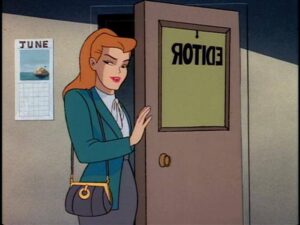
So, this June set episode is a perfect follow-up to “Zatanna” & “Read My Lips” in that the flashbacks from the former talk about a 16 or 17 year old Bruce (we’ll get to Bruce’s age later) saying goodbye to Zatanna and Zatara to travel to Japan (which was mentioned in the latter); in this episode there are more flashbacks set in Japan, which continue this narrative, featuring Bruce training with Kyodai Ken under Yoru Sensei. We know that Bruce is back in Gotham in 1981 because that’s when the flashbacks from “Batman: Mask of the Phantasm” take place; 10 years before that feature film. So that’s how I figured Bruce spent 1979-1980 training with Yoru Sensei. It seems unlikely that Bruce could master all his martial arts skills from just 2 years with Yoru Sensei, so I theorize that Bruce had earlier trained with the senior monk in Nanda Parbat known only as The Master, as revealed in the Justice League Unlimited episode “Dead Reckoning” in a conversation featuring Boston Brand / Deadman (who was introduced in the previous comic):
“He knew The Master even before I did.” – Deadman
“He was one of my martial arts teachers.” – Batman
So it would seem the 2 years spent with Yoru Sensei were spent learning new styles of combat to compliment his previously learned skills.
This episode sets up another sequel, “Day of the Samurai”, which will come into play later in the year.
013 BTAS 05 S01E09 Pretty Poison
This episode serves as the big introduction to Pamela Isley / Poison Ivy but it also serves as an excellent introduction to Harvey Dent, who will eventually become the villain known as Two-Face in 1993. We get a flashback to 5 years ago (1986) which gives both Pam & Harvey a sense of history, while simultaneously continuing the historical tales of Mayor Hamilton Hill & Bruce Wayne. Though Poison Ivy is locked away in Stonegate Penitentiary at the close of the episode, she’s almost always placed in Arkham Asylum after this point; safe to assume she was found insane and placed in Arkham sometime later.
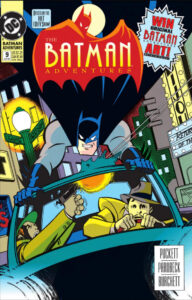
014 TBA Vol. 1 #09 The Little Red Book
Features Harvey Dent, bridging a 3 appearance streak with “Pretty Poison” and “On Leather Wings“.
015 BTAS 01 S01E02 On Leather Wings (July)
The first produced episode of the DC Animated Universe serves as a third outing for Harvey Dent, linking it to the previous 2 installments. There’s also the confirmation that this story begins on July 13 (so after the June set “Night of the Ninja“) per the Bat Computer, which also reveals some of the robberies that have been going on in Gotham over the last few weeks.
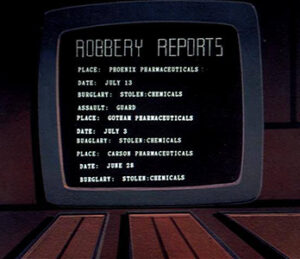
This episode marks the first appearances of Dr. Kirk Langstrom, his wife Dr. Francine Langstrom and her father Dr. March, along with the Man-Bat.
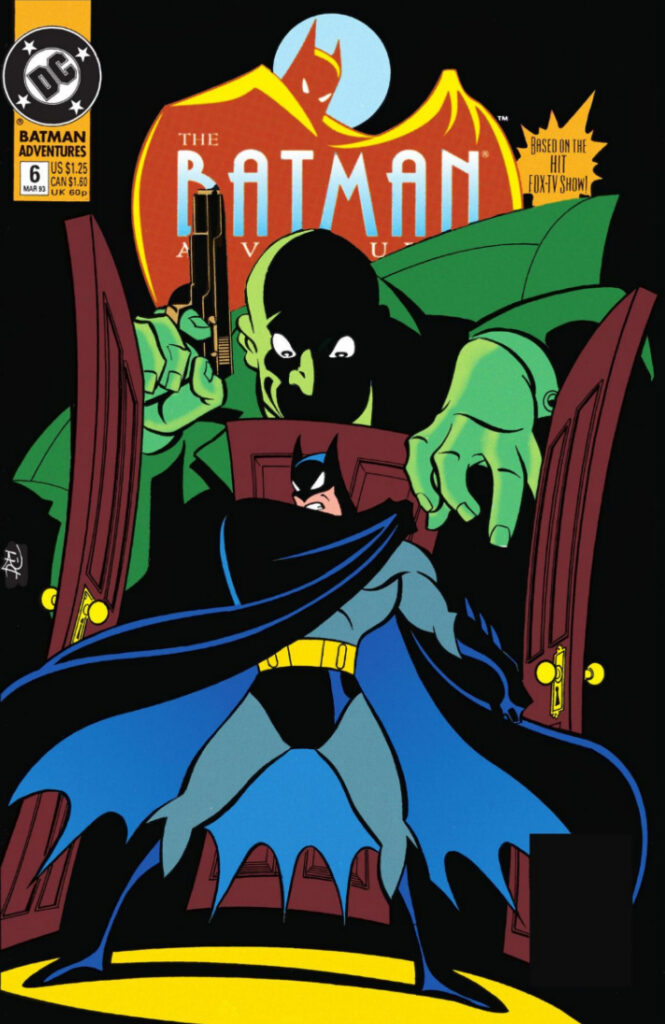
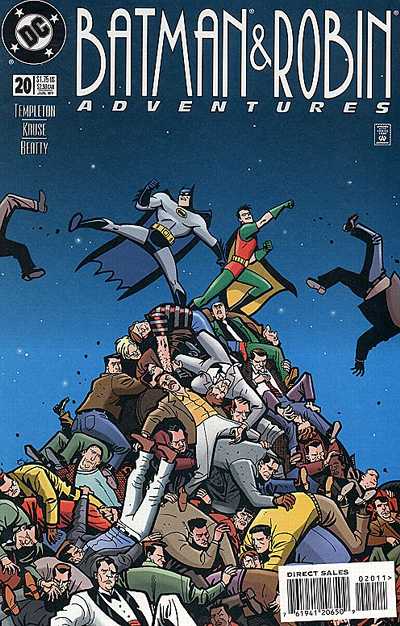
016 TBA Vol. 1 #06 The Third Door
017 BARA Vol. 1 #20 Through the Long Night
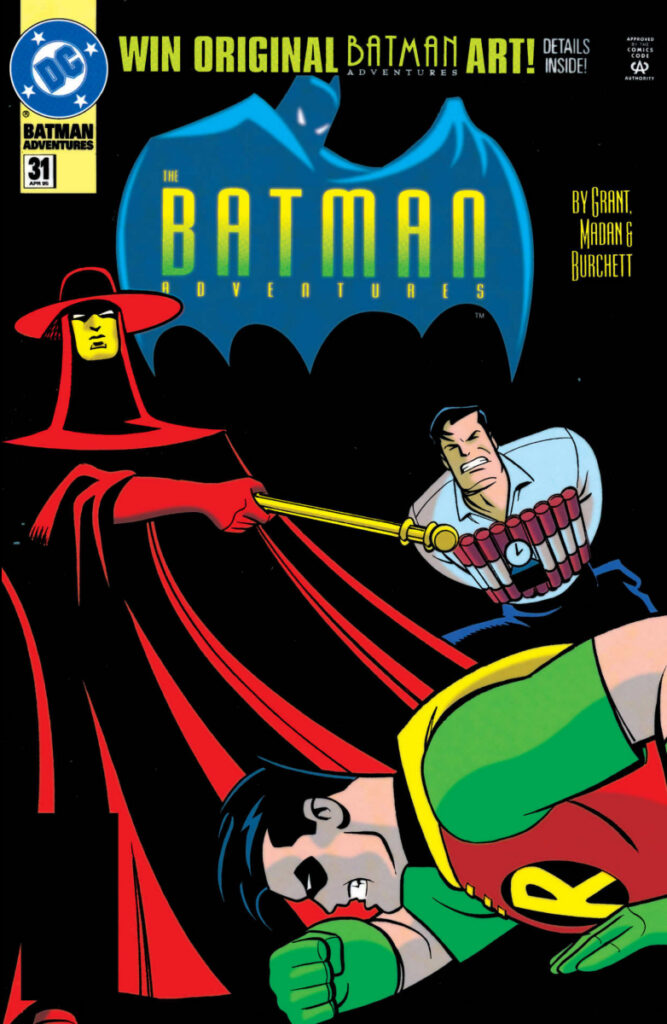
018 TBA Vol. 1 #31 Anarky
All three of these stories fit the criteria to fit into this time frame of Batman: The Animated Series. All of them feature the Dick Grayson version of Robin and none of them feature the Bat-Signal or any of the villains who are introduced later in the series.
019 BTAS 31 S01E25 The Cape and Cowl Conspiracy
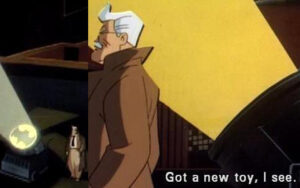
I spoke earlier about my original intent to use “Batman: Mask of the Phantasm” as a jumping off point for the series as it really explains the origins of Batman but how the inclusion of the Bat-Signal precluded that intent. Well this is the episode that introduces the Bat-Signal. I still thought that having “Mask of the Phantasm” set relatively early in the run of the series was a good idea and to allow for that I arranged several episodes and stories to play off one another to allow the story to progress as naturally as possible. The introduction of the Bat-Signal was just the next link in the chain and a key moment in Batman lore.
020 BTAS 38 S01E39 Heart of Steel, Part I
021 BTAS 39 S01E40 Heart of Steel, Part II
These episodes introduce several interesting characters and set up many later stories. These characters include:
Barbara Gordon: the daughter of Gotham City Police Commissioner, James Gordon and the future Batgirl.
Lucius Fox: a well-respected businessman who runs the day-to-day business of Wayne Enterprises.
Karl Rossum: head of Cybertron and the creator of the supercomputer H.A.R.D.A.C..
H.A.R.D.A.C.: (an acronym for “Holographic Analytical Reciprocating DigitAl Computer),
a supercomputer gone rogue.
The Bat-Signal returns and is damaged here.
022 BTAS 44 S01E55 Day of the Samurai
A sequel to “Night of the Ninja” in which Bruce and Alfred travel to Japan to wrap up that storyline; this allows for the off-screen repair of the Bat-Signal while feeling like a completely natural extension of all that we’ve seen prior.
The episode introduces Kairi Tanaga, who returns in the Batman Beyond episode “Curse of the Kobra, Part II”.
There’s a comic sequel to this episode (Batman Adventures Vol 1 #24 “Grave Obligations”) which features a photo of Talia, so set after she’s introduced.
023 BTAS 59 S01E54 Blind as a Bat
The return of the Penguin, Falcone, Sheldrake & Eagleton amongst others, this episode introduces another key Batman character with Leslie Thompkins whose importance will be expanded on later in the year while the inclusion of an apparently repaired Bat-Signal helps set up “Mask of the Phantasm“.
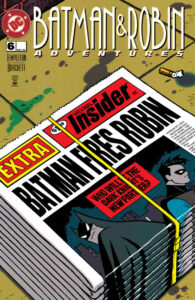
024 TBA Vol. 1 #06 Round Robin
The Bat-Signal is repaired and in use in “Blind as a Bat” but because Bruce is blind in that story he doesn’t show up so it’s important to have another appearance of the signal with Bruce showing up so the line in “Mask of the Phantasm” is reinforced.
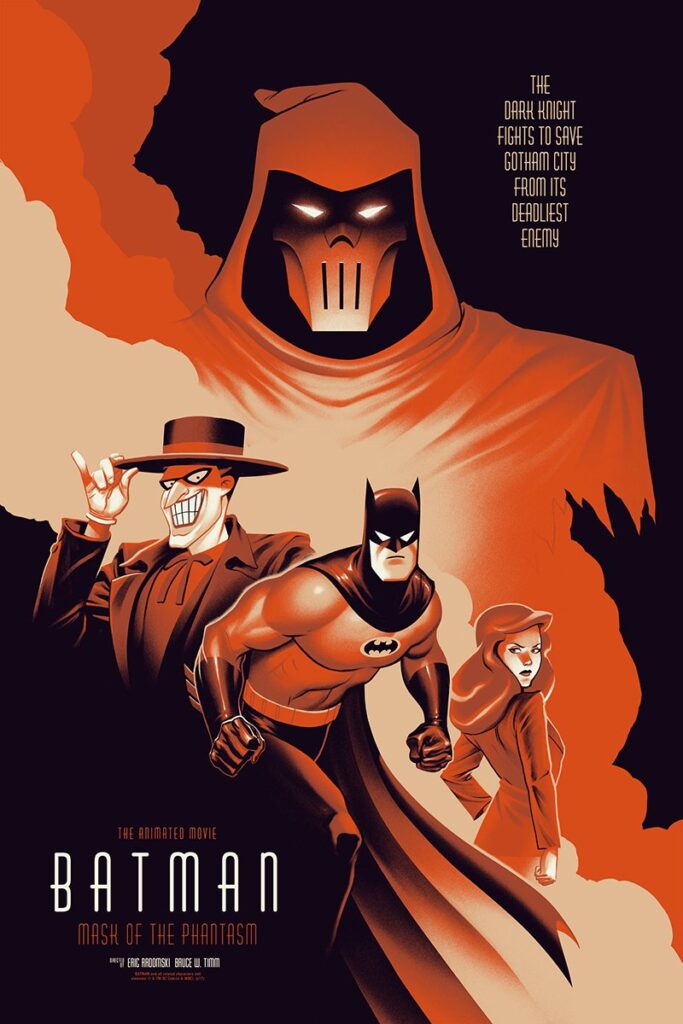
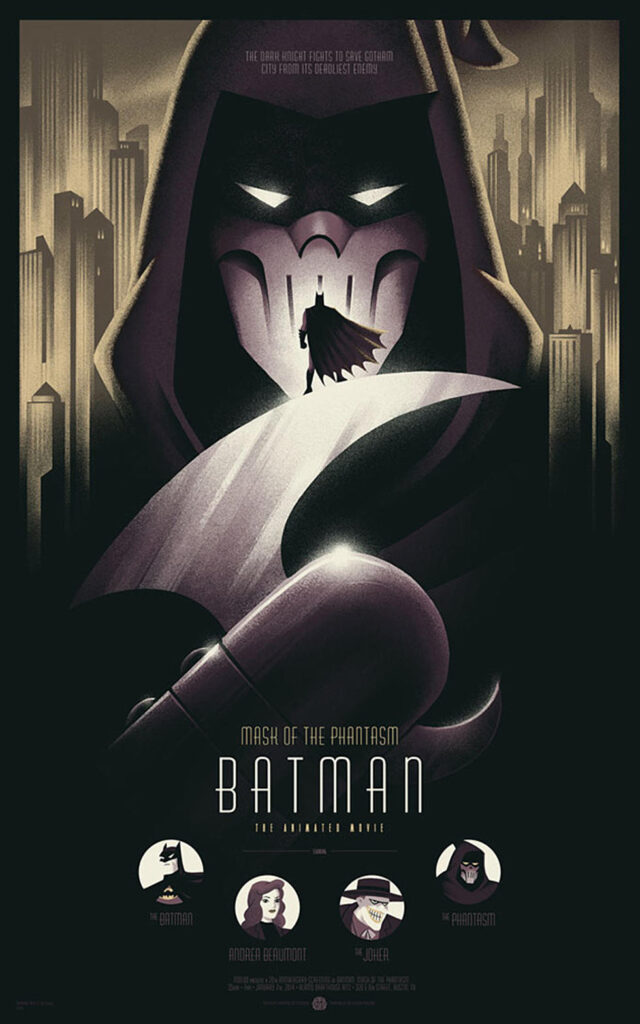
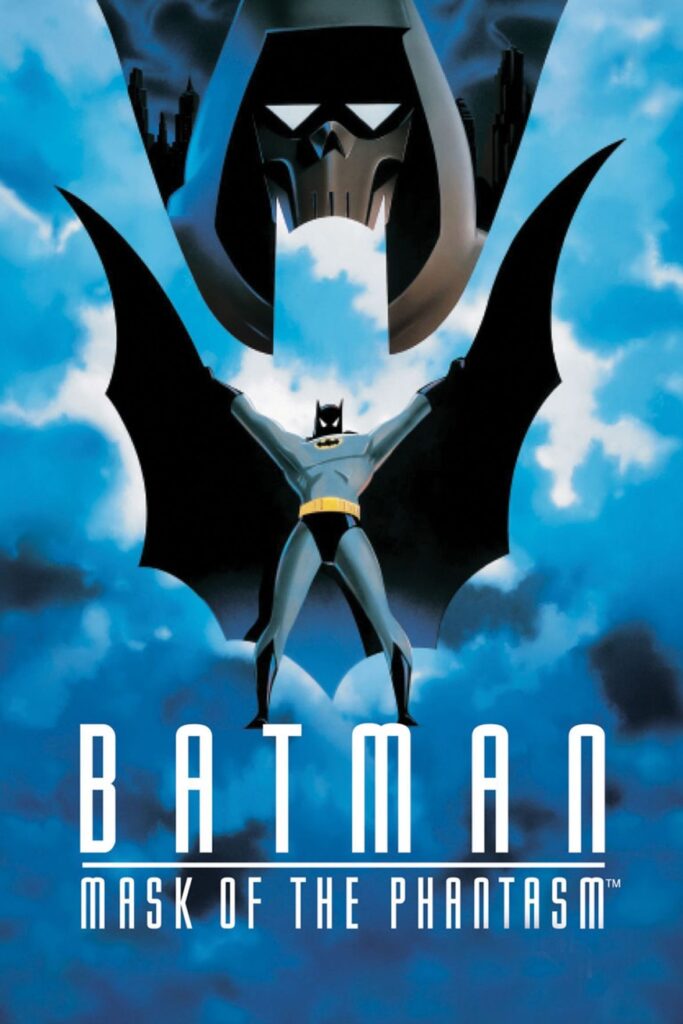
025 DCAU Film #1: Batman: Mask of the Phantasm
“Batman: Mask of the Phantasm”, the first Batman animated film in this continuity, is better than many of its live action counterparts and reveals or alludes to the origins of both Batman and the Joker while introducing still more brilliant characters, including Andrea “Andi” Beaumont and Arthur Reeves, with a silent cameo by Daniel Mockridge. The flashbacks from this entry are set in 1981, 10 years before the film.
This fits perfectly with the flashbacks we’ve already seen, as these are clearly set between the years Bruce trained with Yoru Sensei (1979-1980) & when Bruce (who was already Batman) brought Robin into his care (1982). The story that unfolds in the present is set after the introduction of the Bat-Signal, and a line of dialogue implies that it’s been used several times before…which is supported by this episode order.
In the flashbacks to 1981, Bruce encounters his inspiration for the future design of the Batmobile and is inspired by a sudden fear of bats, revealing the future Batcave, before we see him don the Bat-Suit for the first time ever. Great stuff!
026 BTAS 40 S01E41 If You’re So Smart, Why Aren’t You Rich?

Daniel Mockridge (who’s introduced in this episode), or someone who looks very similar to him can be seen in the party setting of the previous installment. I thought that placing this episode directly after “Mask of the Phantasm” might help strengthen that admittedly tenuous link. This episode introduces Batman villain the Riddler, who escapes at episode’s end, setting up a sequel.
Flashbacks to 1989; 2 years before this story.
027 BTAS 20 S01E04 Feat of Clay, Part I
028 BTAS 21 S01E05 Feat of Clay, Part II
Clayface, one of my all-time favorite villains, is introduced here. Clayface seemingly dies here – but escapes, which Batman suspects.
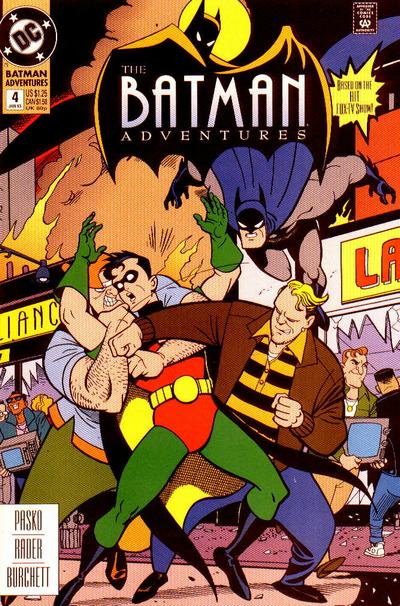
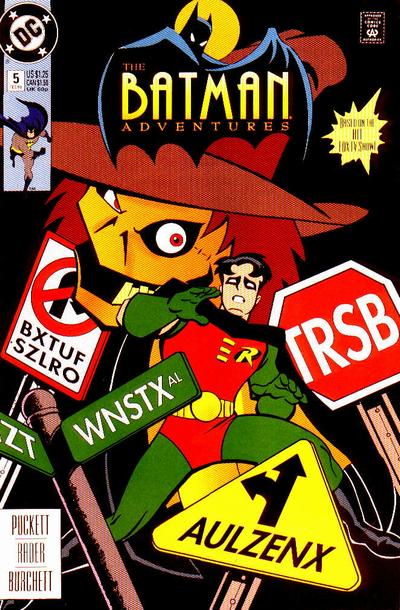
029 TBA Vol. 1 #04 Riot Act
030 TBA Vol. 1 #05 Riot Act II
Scarecrow is free. Batman has just fought Clayface. The Bat-Signal is featured. Part II reveals that Crane (still haunted by his Fear Toxin from “Nothing to Fear”) was part of a work release program that allowed him to teach again, explaining how he was able to set this plan in motion.
031 BTAS 48 S01E45 What Is Reality?
The Riddler, having escaped in B:TAS 40 S01E41 If You’re So Smart, Why Aren’t You Rich?, returns here. Riddler is trapped indefinitely within a simulation at the end of the episode and it’s unknown at the time if he’ll ever recover, though of course he does. But it makes sense that he wouldn’t be showing up for several episodes, at least.
032 BTAS 15 S01E01 The Cat and the Claw, Part I
033 BTAS 16 S01E08 The Cat and the Claw, Part II
This is the introduction of Selina Kyle / Catwoman. Unlike the Joker & Penguin there is a very clear order to the Catwoman episodes in Batman: The Animated Series so placing this story here sets up all sorts of other stories. One of the stories that it sets up is “Cat Scratch Fever“, which features snow. The thing about the DC Animated Universe is that there aren’t a lot of episodes that feature snow and most of those that do seem to be holiday type episodes…and there just aren’t enough of them to go around. Also, this suggests that winters in the DCAU. are shockingly mild. Since holiday episodes seem to have snow it seemed like a good idea to end each year with a snowy episode if I could and having “Cat Scratch Fever” help close out the year seemed to mesh with everything else I’d discovered. To get to that story I had to introduce Catwoman and this seemed like a good place to do so; the two stories take place almost consecutively (there’s some wiggle room that allows for a story or two to be set between them) and this served my sense of completeness rather nicely. So here is where the episodes landed. Several more Catwoman adventures follow closely behind.
034 BTAS 60 S01E43 His Silicon Soul
The emotional return of H.A.R.D.A.C. & Karl Rossum provides closure to much of their introductory story, though Rossum will return in further installments.
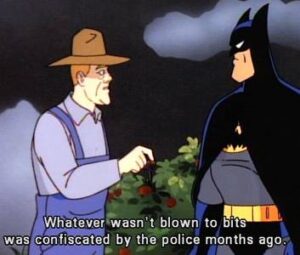
This episode actually fits here perfectly as the episode reveals that it’s set months after “Heart of Steel”.
035 BTAS 26 S01E12 Appointment in Crime Alley (November)
This episode is set on the anniversary of the night that Bruce’s parents were murdered. No date is given in the episode, but the series shares some continuity with the first two Tim Burton directed Batman movies, which were themselves inspired to some degree by the graphic novel “The Dark Knight Returns”. In that comic Bruce’s parents were killed after seeing “The Mark of Zorro” with Tyrone Power which opened in November 1940. We know that the animated version also follows this continuity point to a degree thanks to a flashback in the Justice League Unlimited episode “For the Man Who Has Everything“:
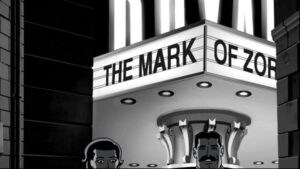
I decided to keep that homage intact, but to keep Bruce’s age in check I theorized that Bruce’s parents took him to see the 30th Anniversary of the film in November of 1970; that’s where the November date of this episode springs from and why every anniversary of these events are set in November. This is also how I calculated Bruce’s age within the D.C.A.U.; It has been alluded in several episodes that Bruce was 8 years old when his parents were murdered.
Justice League episode “The Savage Time, Part I“: “The stormtroopers came to our house. I was 8 years old.” – Alternate Universe Batman
Justice League episode “A Better World, Part II“: “…we’ve made a world where no 8 year old boy will ever lose his parents because of some punk with a gun.” – Justice Lord Batman (to Justice League Batman)
Justice League Unlimited episode “Kid Stuff“: “I haven’t been a kid since I was 8 years old.” – Bruce Wayne
Justice League Unlimited episode “Epilogue“: “Stop me if you’ve heard it before. You’re 8 years old. Your parents have just taken you to a rousing adventure film; a grand time is had by all. But unknown to you a mysterious figure hides in the shadows. My plan was simple: the killer would leap out at you and kill your family. The trauma would put you on the path to becoming Batman.” – Amanda Waller
If Bruce is 8 years old when he sees the 30th Anniversary release of “The Mark of Zorro” in November 1970, then it follows that Bruce would most likely have been born in 1962; 8 years before those events.
Leslie Thompkins, who was revealed as Bruce’s personal physician in “Blind as a Bat”, who is completely aware of his secret identity as Batman, gets plenty of character development here and Roland Daggett returns from the recent “Feat of Clay” two-parter.
036 BTAS 35 S01E33 Cat Scratch Fever (Snow)
1991’s ending begins in a snow filled episode that continues Catwoman’s storyline in a logical manner, picking up at Selina Kyle’s sentencing and ending on a positive note with Selina’s future as Catwoman uncertain but hopeful. Both Roland Daggett and Doctor Achilles Milo (the latter introduced here) will return. Catwoman’s story will pick up again in early 1992.
037 BTAS 02 S01E38 Christmas with the Joker
“Christmas with the Joker” features Joker escaping from Arkham; he’s captured at episode’s end and the episode is set on December 24 (Christmas Eve) & December 25 (Christmas Day). A cardboard cutout audience member resembles Harvey Dent.
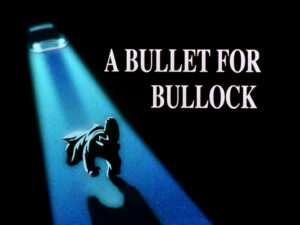
038 BTAS 67 S04E04 A Bullet for Bullock
“A Bullet for Bullock” is set in the week between December 25 & December 31: